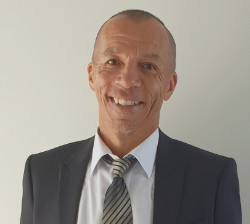
Introducing our expert: Jérémie Yao
For this new Expert Insights session, we had the pleasure of interviewing Jérémie Yao, Sales Director at My DSO Manager. With over 15 years of experience in Credit Management within international groups, Jérémie has held several key positions before joining My DSO Manager, where he now supports companies in structuring and digitalising their accounts receivable management.
His career gives him a 360° view of the profession: from operational realities to strategic decision-making, from risk management to commercial relationships. Accustomed to working closely with finance, sales and legal departments, he shares in this series both a technical and human perspective on the profound transformations reshaping Credit Management.
Through his words, we discover a professional who is deeply passionate about his role, convinced that performance relies as much on data and tools as on listening, knowledge-sharing and understanding others.
From paper sheets to real-time data
For Jérémie Yao, there is no doubt about it: the Credit Management revolution is called digitalisation.
A profession once rooted in “printed paper statements” has shifted to a world of data, analytics and continuous reporting. This transformation has changed both the pace and the very nature of the work:
Real time is almost already too late
, he likes to say. What really matters now is anticipation.
Today’s Credit Manager must therefore stay one step ahead: identifying weak signals, leveraging data and integrating predictive analytics into decision-making.
For Jérémie, this evolution is comparable to all past technological revolutions: each generation believes it is living through something exceptional, yet progress always goes further. Digitalisation is only one stage; further transformations are still to come.
Large corporations and small businesses: Two complementary models
When asked about the differences between Credit Management in large international groups and in SMEs, Jérémie describes two worlds that complement each other.
In large groups, it’s all about structure: access to resources, clear organisations, defined responsibilities, and service dimensions with very specific roles. […] You put a contract in place: there’s a legal department. You talk about VAT practices: there’s a tax department.
In smaller organisations, agility and versatility are gained but at the expense of deep specialisation:
In a smaller company, there is more versatility and therefore more agility, that’s true, but less in-depth expertise in a specific field. […] We handle customer accounting, dunning, part of sales administration, as well as all the related administrative tasks.
For Jérémie, neither model is better than the other:
- in large groups, you gain recognition and credibility;
- in SMEs, you develop a global understanding of the business.
Both are good
, he sums up simply. It all depends on personality and what you are looking for: specialisation or a holistic view.
His own career perfectly illustrates this point. After several years in a highly structured large group, he joined My DSO Manager and, as he puts it, “stepped through the looking glass.” This transition allowed him to apply everything he had learned to help build a new approach to the profession.
CSR: A new criterion in risk assessment
The link between CSR (Corporate Social Responsibility) and Credit Management is becoming increasingly tangible. Jérémie sees this every day: tenders now systematically include a CSR component, almost as important as financial statements.According to him, Credit Managers must therefore integrate this dimension when setting credit limits—taking into account not only financial performance, but also a client’s environmental and social behaviour. Choosing not to ignore these criteria means contributing to broader progress:
Do I grant more credit to a company that generates excessive waste?
he asks.
Or, on the contrary, do I limit my exposure in order to be fairer?
The question is no longer purely financial it has become ethical.
From gatekeeper to business partner
Long perceived as the “guardian of the financial temple”, the Credit Manager must now evolve into a business partner. Jérémie is careful to stress that this role is far from theoretical it first requires speaking the language of the business.
Business partner’ is a fashionable term, but behind it lies a reality: you must speak the language of the business. If I talk to sales using only financial jargon, we won’t understand each other.
He explains the expected mindset:
You need to adopt an advisory posture: I’m not here to give orders, but to provide guidance, understand needs, and be reactive and agile. […] If the language remains opaque, sales teams feel almost attacked and stop consulting you.
This approach reconciles two worlds often seen as opposites: finance and sales. For Jérémie, one principle remains constant:
Everything is communication. It was true yesterday, it’s true today, and it will be true tomorrow.
Cash culture: A shared responsibility
This naturally leads to the concept of cash culture, often mentioned but sometimes misunderstood. For Jérémie, it concerns everyone:
Every employee must understand that their actions contribute to the company’s survival: paying salaries, paying suppliers. […] Cash culture is not just about collecting what we are owed; it’s also about asking: what level of risk control can I exercise at my own level?
He gives a simple but telling example that combines CSR and cash considerations:
Lights turning off when no one is there: there’s a CSR aspect, but there’s also a cash aspect. […] It’s not just about the environment there’s a bill at the end of the month!
This culture is not limited to sales teams. Jérémie has also seen finance professionals lose sight of the real objective behind their spreadsheets:
Some become Excel experts but forget the meaning of what they are measuring.
Conversely, sales teams understand customer value very well—but sometimes need to be reminded of a simple truth: a good customer is also one who pays.
Human qualities at the heart of the role
When it comes to building high-performing teams, Jérémie places human qualities above technical skills: listening, communication, mental agility and empathy. The ability to understand different perspectives opens the door to better solutions:
Those who can understand even someone who doesn’t share their position already have a head start
, he says. It is this open-mindedness that enables us to build sustainable solutions.
Putting yourself in someone else’s shoes, understanding reactions and anticipating disagreements these are the instincts that, in his view, distinguish a true professional.
Through his insights, Jérémie Yao paints the portrait of a modern Credit Manager: connected, communicative, responsible and human. His message is clear: technological progress does not replace human intelligence, it enhances it.
Coming up in the next episode
 Information systems, organisation and performance steering: ERP systems, dedicated tools and DSO at the heart of the game.
Jérémie Yao will explain how ERP systems have structured the profession, why hybrid organisations are becoming essential, and how DSO remains the key indicator for managing global performance.