
“Much of the conventional economic wisdom prevailing in financial circles, largely subscribed to as a basis for governmental policy, and widely accepted by the media and the public, is based on incomplete analysis, contrafactual assumptions, and false analogy.”
“Let us clear from the ground the metaphysical or general principles upon which, from time to time, laissez-faire has been founded. It is not true that individuals possess a prescriptive ‘natural liberty’ in their economic activities. There is no ‘compact’ conferring perpetual rights on those who Have or on those who Acquire. The world is not so governed from above that private and social interest always coincide. It is not so managed here below that in practice they coincide. It is not a correct deduction from the Principles of Economics that enlightened self-interest always operates in the public interest.”
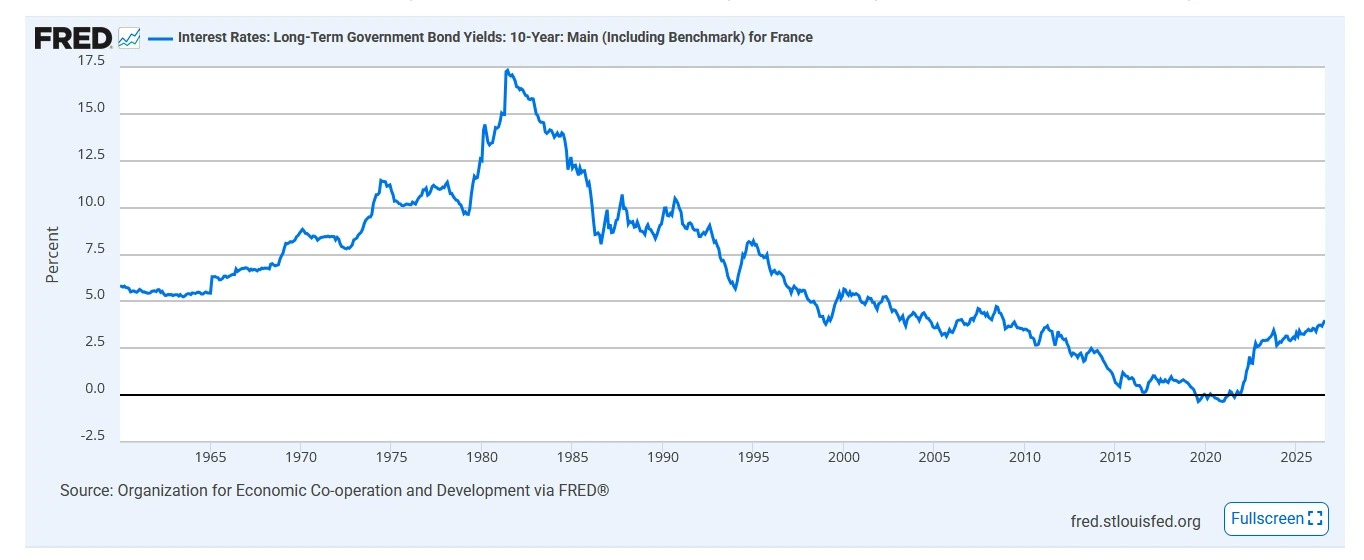
France\'s public debt is everywhere in the news, and there is little doubt it will take centre stage in the presidential campaign. In newspapers, on the radio, on 24-hour news channels and across social media, economists and self-styled experts (politicians, journalists, advisers of every kind) take turns explaining why it is a problem, what caused it, and what must be done to spare the country a “Greek-style scenario” (sic) – a genuine financial catastrophe. The debate is not new – it goes back several decades – but the rise in interest rates on government borrowing that we are now witnessing (see the charts in the appendix) is, rightly, a cause for concern. Most of the measures put forward on all sides therefore aim first and foremost to halt it, or even reverse it, as quickly as possible.
Debt is sustainable as long as growth outpaces the interest rate
It can indeed be shown that public debt is only sustainable – this is an accounting principle – if the interest rate attached to it is lower than the economy\'s growth rate, debt “sustainability” being defined as the stability of the State\'s debt ratio (public debt divided by the country\'s GDP) below a threshold set in advance (for example 60%). As long as the growth rate of the national economy (and therefore of total income) remains higher than the interest rate, the debt does not feed on itself through exorbitant interest rates that, month after month, keep making it heavier. In other words, this condition protects the nation from a snowball effect set off and sustained by the very mechanics of debt – truly the worst thing that can happen to a country: public debt “explodes” (what we call a debt crisis), with well-known consequences (financial crash, panic, depression, unemployment, poverty, and so on).
In itself, debt (public or private) is “neither good nor bad”. It all depends on what is done with it and how it is managed. Economic history, and that of modern capitalism in particular, confirms the decisive role of debt as the fuel every economy needs to grow. But it also shows that debt can cause serious economic, social and political problems. Nobody will dispute, then, that public debt is a legitimate subject of debate. But it still has to be debated properly – that is, by discussing all its aspects, not just a few, while the others are assumed to be negligible, already settled, ridiculous, absurd or non-existent.
Financing public debt: is the market the only way?
From this point of view, the debate we are witnessing in France (and elsewhere) is a textbook case. Commentators pile up diagnoses, opinions and recommendations on taxes and/or public revenue, sometimes divergent, even diametrically opposed. Yet beyond their differences, everyone seems to take it for granted that there is, for a State, only one way to finance its debt: by turning to the market – in this case, the financial markets.
And indeed, that is the rule today. The French State (like many others) has to finance its budget deficits by borrowing on the financial markets (in practice, mainly banks, insurance companies and various investment funds), with the immediate consequence that it must live with interest rates it does not control, since they result from the “free” interplay between the amounts sought (by the State) and offered (by “the market”). Financial markets which, moreover, are now “globalised” – hence, and this is not the least of the problems, a growing dependence on foreign investors (around 56% of France\'s public debt is currently held by foreign operators). But “today” is one thing; “always” is another.
The neoliberal paradigm: a political choice, not a law of nature
This way of organising the financial system is rooted in a very particular framework of thought (a doctrine – some would say a “paradigm”), namely a form of “neoliberalism”. For neoliberal orthodoxy (inspired by thinkers such as F. Hayek and M. Friedman, to name only the best known), the expansion and liberalisation of markets are the sine qua non of prosperity and progress. Market logic must therefore govern all economic activity, with the exception (and even then) of activities linked to the sovereign functions of the State (army, police, justice). Here, this worldview implies the liberalisation (deregulation) of the financial sector at national level or, better still, across all countries (financial globalisation), and gives markets the central role in the financing system. From then on, the only option open to the State to finance a budget deficit is to borrow on the financial markets, on which it becomes dependent, both for the amounts raised and for the interest rates it will have to pay – with the ever-present risk of rates that “soar” to the point of threatening its stability. Exactly the situation we are now witnessing.
This paradigm took hold in universities and began to be applied in the United States and Britain at the turn of the 1980s, and in France with the reforms of 1984 and 1985, where it has never been seriously challenged since, whatever the political colour of the government in power. The European Union, for its part, “carved it in stone” in its institutions with the Maastricht Treaty (1993) and most of the treaties that followed (independence of the European Central Bank, annual budget deficit and public debt capped at 3% and 60% of GDP respectively, obligation to finance public debt through the markets). And, having been presented over and over as “the only possible alternative”, it ended up taking hold in people\'s minds as self-evident, a “natural” law which, by definition, one can do nothing about but submit and adapt.
Yet it is, by definition, no more than a set of ideas forming a system – one ideology among others. And as such, nothing prevents us from questioning it. In fact, both history and economic theory (especially from the 1930s onwards) refute the validity of the “neoliberal” worldview (see the Vickrey quote at the top of this article). The Trente Glorieuses (France\'s post-war boom) yesterday, China today (it goes without saying that pointing this out implies no endorsement whatsoever of the doctrine and totalitarian practices of the Chinese political regime) are enough to refute its claim to universality and to show that the way a country finances its public spending is in no way dictated by implacable natural laws, but results from a political choice, claimed and owned as such. There is nothing self-evident or compulsory about entrusting the financing of the economy to the financial markets alone. An alternative exists. The problem is that, with very rare exceptions, it is never mentioned in the debate – a rather strange omission, the reasons for which would deserve to be analysed.
The forgotten alternative: a budgetary golden rule and a public bank
This alternative offers an entirely different way of looking at the question – and therefore a radically different programme which, in broad terms, could include the following measures.
First, enshrine in the Constitution a budgetary “golden rule” (nothing to do with the one regularly cited in the media) requiring the government, every year, to draw up not one but two budgets: the first covering its operating expenditure, the second reserved for investment, with the rule that only the latter may be financed by borrowing (the operating budget would have to be balanced). Second, the creation of a public bank whose sole mission would be to manage the public borrowing required to finance the country\'s enormous investment needs – in innovation, ecology and education – without which the future of our societies is, frankly, more than compromised. It would be tasked with channelling the savings of carefully selected investors, could resort to money creation if necessary and, last but not least, would have authority over interest rates, which it would simply set by applying the rule described above (the debt sustainability condition), so that the interest rate always remains below the economy\'s growth rate.
These first measures would call for others, just as far-reaching (radical), involving in particular a reversal of the sacrosanct independence of the central bank, the reintroduction of a principle of banking separation forcing banks to choose between lending and purely financial activities, and planning worthy of the name in the service of a genuine industrial policy.
A programme that is neither right nor left
This programme is neither right-wing nor left-wing. Within both political camps – and not only in France – there have always been men and women who have supported it, championed it and sometimes even partly implemented it.
Nor does it in any way run counter to the “spirit” of a well-understood capitalism. Quite the opposite, since its aim is to set the economy “the right way up”, with a monetary and financial system serving the real economy (businesses first, the State second) rather than the other way round. It is no coincidence that it always regains interest after a war or a major financial crisis…
Its measures will seem particularly restrictive for players in the banking and financial sector first, but also for anyone who entrusts them with their savings (households in particular). That is probably the heart of the matter: the “old” question of how far a society accepts and decides to leave individuals free to make their own choices in their economic activities. A question that also remains open to debate (see the Keynes quote at the top of this article – and Keynes was anything but a Bolshevik).
Finally, it is clear that implementing it would not be straightforward. The programme carries risks (the Chinese model offers several illustrations of them), and it is obviously incompatible with the European treaties.
But saying that a programme (a measure or a law) is difficult to apply is one thing; ignoring it, “forgetting” to mention it, and thereby suggesting that there is “no alternative” to the current model is quite another. The very least one can do when addressing these issues is to present and discuss all the possible solutions, leaving none out, so that everyone can form an informed opinion and express their preference.
The chart below shows the long-term trend in the interest rate on 10-year bonds issued by the French State on the markets, from 1960 to August 2026 (when the rate reached 4%).
The chart below zooms in on the recent period (September 2026).
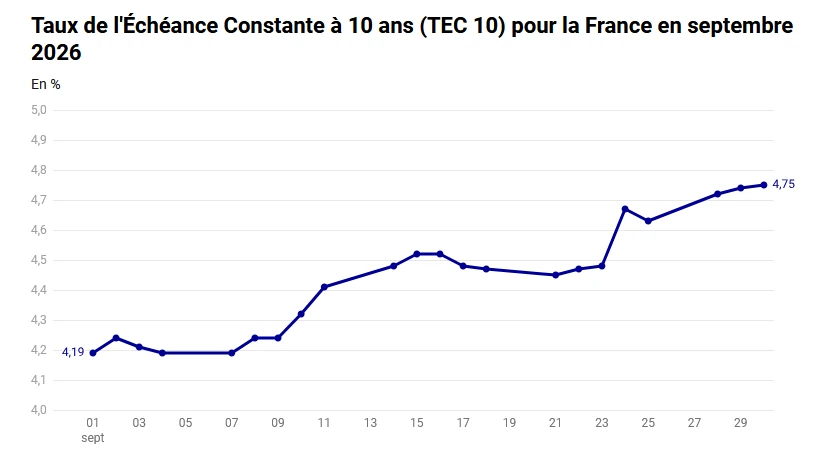
It should be added that on 2 October, the rate stood at 4.90% (source: Agence France Trésor).
It should also be noted that the crucial criterion of public debt “sustainability” (an economic growth rate higher than the interest rate) has no longer been met since 2025…