E-invoicing is spreading fast, but being compliant is not the same as getting paid on time. That is the message of Tungsten Automation's e-Invoicing & Payments Benchmark Report 2026: 43% of organisations have fully implemented e-invoicing domestically, yet for the vendor, compliance is only the baseline. The real question is what you build on top of it.
For UK finance teams, the timing matters. E-invoicing is set to become mandatory for VAT invoices from April 2029 (CFOtech), and the Commercial Payments Bill would cap B2B payment terms at 60 days. Here is what the report tells credit controllers and finance directors preparing for both.
The key figures of the report
Finance teams see themselves as advanced, but e-invoicing is often still treated as a standalone obligation. The report is based on a survey of 1,150 finance leaders across 7 countries, including the UK and France; nearly half are CFOs or financial controllers.
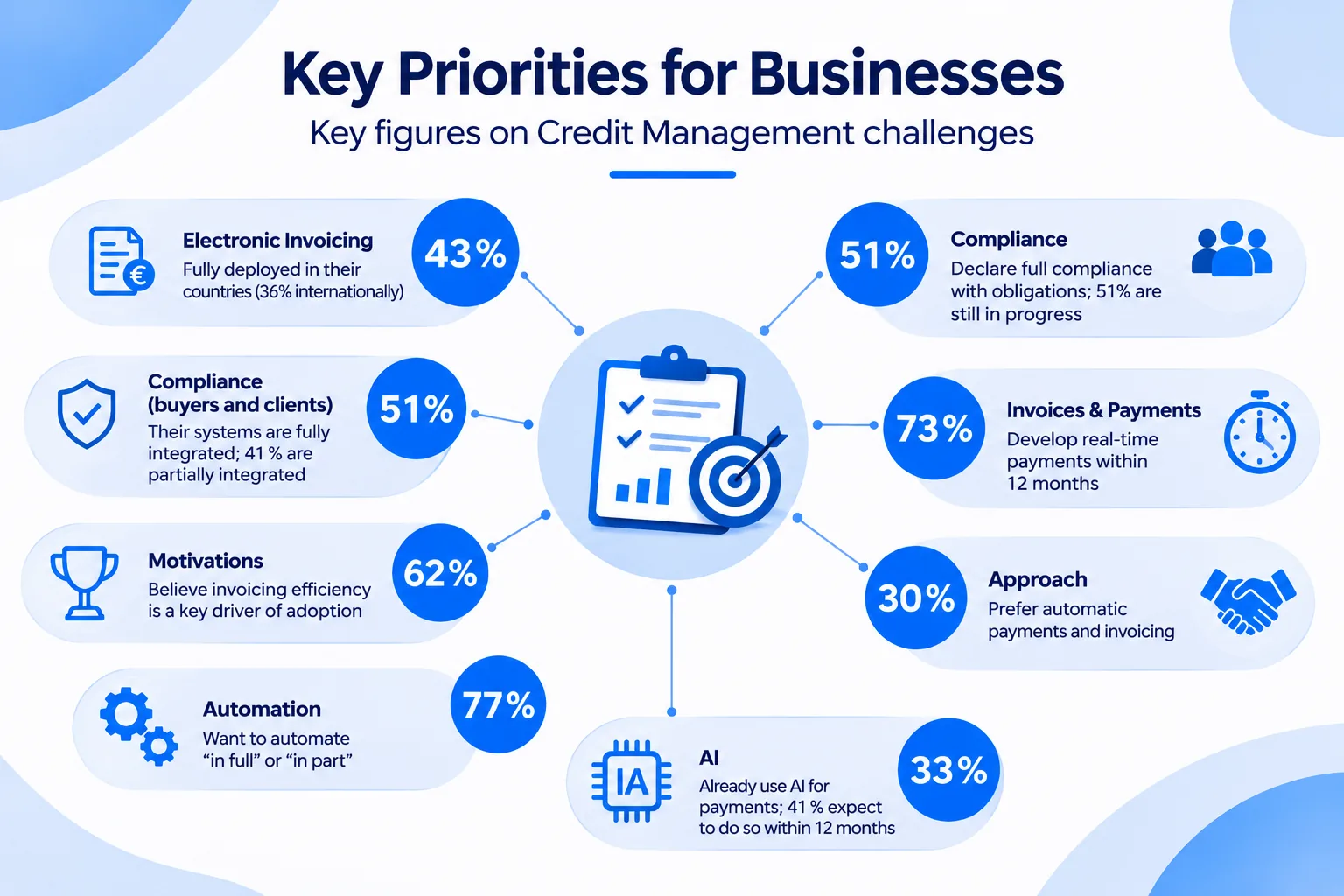
The report also finds that the UK, France and Germany lead in confidence to meet e-invoicing deadlines. Fraud risk (48%) and integration costs (44%) are the top barriers to real-time payments.
What it means for UK credit controllers
E-invoicing speeds up how invoices are sent, not how they are paid. Between the invoice reaching the customer and the cash arriving, the core work of credit control remains: tracking due dates, chasing, resolving disputes and anticipating late payment. Our guide to electronic invoicing and cash collection explains how to adapt your process step by step.
Invoice statuses change how you chase. E-invoices carry standardised data and status updates (delivered, approved, disputed, rejected). A rejected or disputed invoice can be dealt with before the due date, instead of being discovered when the first reminder goes out.
Shared visibility reduces friction. According to the report, a real-time view of invoice status shared by buyer and supplier replaces chasing and querying with clarity, and speeds up the cash conversion cycle. Yet only 51% of organisations have fully integrated payables and receivables systems. That matters even more once the Commercial Payments Bill requires disputes to be raised before the due date.
Cash forecasting is a growing expectation. 53% of organisations expect AI and analytics to improve cash-flow forecasting. Structured invoice data, combined with each customer's payment history, makes that forecast more reliable.
5 steps from compliance to collection
- Use invoice statuses. Feed e-invoice statuses into your credit control process so you know which invoices are accepted, rejected or disputed.
- Chase on events, not just dates. Trigger reminders and escalations from invoice events (rejection, dispute, due date approaching or passed), not only on a fixed schedule, using well-designed collection scenarios.
- Resolve disputes before the due date. A dispute flag should alert sales or customer service straight away, so it is fixed before the invoice becomes overdue (disputes management).
- Segment customer risk. Combine payment history and invoice statuses to tailor reminders and terms to each customer.
- Track DSO and forecast cash. Monitor DSO, late payment by customer and the share of disputed invoices to prioritise action and forecast collections.
Conclusion
E-invoicing is a compliance requirement, but also a chance to manage everything that happens between sending an invoice and getting paid. The businesses that gain most will be those that use this new data to chase at the right time and cut late payment. For the rest, compliance will be a cost with no effect on DSO.
See how My DSO Manager helps you chase at the right time, resolve disputes earlier and reduce DSO.
Book a demo