
Artificial intelligence promises to revolutionise Credit Management. But beyond the marketing hype, where does performance really lie?
Key takeaways
- 1AI is a tool serving a credit policy, not a strategy in itself.
- 2The real transformation of Credit Management comes from system interconnection and real-time data.
- 3AI only multiplies performance when data, processes and business rules are solid.
- 4The Credit Manager is not disappearing: they are becoming the architect and pilot of their processes.
One day, a project manager on my team came up with the following (incorrect) equation:
Business Intelligence (BI) = Artificial Intelligence (AI)
Simplifying, we get: Business Intelligence = Intelligence Artificial, i.e. Business Artificial (BA).
This is indeed one of the facets of AI.
In our sector, Credit Management, many players now talk about nothing but AI, as if managing one of the company's most important processes, order to cash, could be reduced to this single technology. There is a name for it: AI washing, or AI marketing. But what has become of intent, of the company's credit policy, of the technical skills and expertise needed to master the many dimensions of this profession? Our websites Credit Management Tools / Etre payé, which aim to make Credit Management accessible to everyone, contain several hundred tutorials on this profession. And yet they are far from exhaustive.
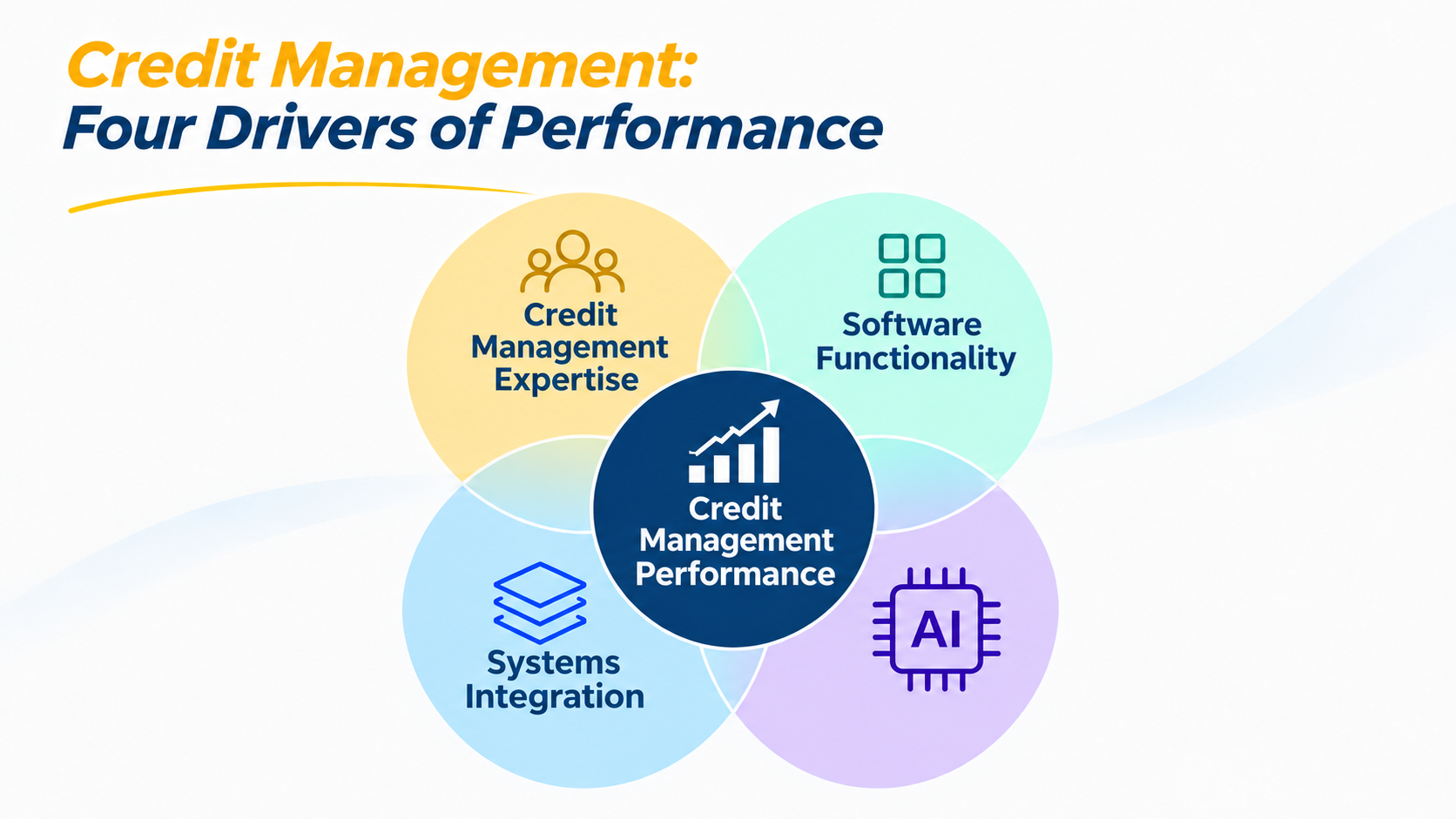
Philippe Wieczorek, Director of the MIAI Cluster IA at Université Grenoble Alpes, recently told me: "I wouldn't get on a plane flown by an AI." Philippe Wieczorek, Director of the MIAI Cluster IA Does this mean AI is useless in an aircraft? Certainly not. Assistance and automation technologies already play a considerable role there. But they are part of a system designed, controlled and supervised by professionals who take responsibility for it. The same principle applies to Credit Management. AI does not define a company's credit policy, its cash targets, its risk appetite or the trade-offs it wants to make between business growth, profitability and customer satisfaction. It can help inform these decisions and implement them. But it cannot replace the strategic intent that guides them. Artificial intelligence only has value if it serves business intelligence. And the more powerful the tools become, the higher the skills needed to master them. The Credit Manager must now extend their expertise beyond the traditional fields of the profession, towards understanding and leveraging the most advanced technologies to implement their strategy and achieve their objectives. Make no mistake. Most of the added value of a credit management software such as My DSO Manager does not lie in AI taken in isolation, but in its functional richness, its interconnectivity, its agility and its ability to translate a credit policy into efficient operational processes. AI needs these foundations to be truly useful and relevant. Because Credit Managers face no shortage of challenges: a growing number of companies in financial difficulty, insolvency proceedings, geopolitical risks, the complex rollout of electronic invoicing, increasingly complex accounts payable processes, economic tensions, and so on. Most of these risks have existed for a long time. But they are changing in nature and scale, and above all, the means of dealing with them effectively have evolved considerably. When it comes to customer risk management, information has never been so abundant, yet it often remains scattered across a multitude of sources and systems. The first challenge is to centralise it, make it reliable and usable in a single environment, for dynamic credit analyses that generate appropriate actions. In cash collection, the gradual integration of sellers' and buyers' systems, driven in particular by platforms and the electronic invoicing reform, is profoundly transforming practices. Data exchanges are becoming smoother, faster and more automated. Information on invoices, payments, disputes and customer behaviour can be used far more consistently and systematically. Because this is one of the long-standing challenges that digitalisation and AI address: making sure no receivable slips through the Credit Manager's net. This environment makes any disconnected practice obsolete and inefficient. Data interconnection considerably strengthens the relevance and effectiveness of AI, while gradually making certain practices obsolete, such as mass phone call campaigns. Human intervention remains fully valuable in situations requiring negotiation, judgement and relational intelligence, particularly to resolve complex commercial disputes. In B2B cash collection, using AI-automated phone calls even proves counterproductive. Let us use discernment: performance does not lie in using AI systematically, but in the ability to use it where it brings real added value. Interconnection also concerns the company's internal stakeholders. Digitalisation makes it possible to involve sales, finance, accounting and operational teams much more directly in Credit Management challenges: cash, profitability, risk control and customer satisfaction. It is also developing vertically, at the scale of international groups. For example, My DSO Manager makes it possible to consolidate data from multiple entities in real time, along with performance indicators such as DSO, overdue amounts and cash collection forecasts, for groups operating worldwide with dozens of currencies. This consolidation provides global visibility and a capacity for action that was previously unimaginable. In a context of growing risks, decisions to grant or review credit limits can thus be better shared, submitted to the appropriate levels of responsibility and fully traced. The transformation of Credit Management relies first and foremost on this ability to connect information, processes and people. It is on these foundations that AI comes into its own. When it has reliable, up-to-date and contextualised data, and is integrated into consistent business processes, AI can deliver considerable gains. It makes it possible to analyse payment behaviour and adapt collection strategies accordingly, detect risk situations, prioritise collection actions, interpret customer responses, suggest the most relevant next actions, or automate a growing share of interactions. The same number of people in a Credit Management team can now handle more situations, act faster and create much more value. But AI does not magically fix an organisation's weaknesses. Warning An AI fed with incomplete data, integrated into poorly designed processes or lacking relevant business rules risks automating dysfunctions rather than solving them. Conversely, a high-performing digital solution, combined with solid business expertise and well-used AI, opens up very significant opportunities for improvement. Business expertise defines the strategy. System interconnection makes information available and usable. Functional richness translates this strategy into efficient operational processes. Artificial intelligence multiplies its power. It is the combination of these four dimensions that makes up the real Credit Management revolution. The paradox of our time is that we are considerably increasing the means of performance through digital solutions, AI included, while downgrading the very player behind that performance, the human, to the point of imagining they could be useless. Of course, AI automates many tasks, including some that previously required specialised skills (credit analysis, for example). The Credit Manager's profession is therefore evolving profoundly. But this evolution does not mean their added value is disappearing, quite the opposite. Less tied up with repetitive tasks, the Credit Manager can spend more time defining their Credit Management strategy, anticipating risks, making complex trade-offs, coordinating stakeholders and continuously improving performance. They become more of an architect and pilot of their processes, while remaining responsible for decisions and their consequences. They can even go further and tackle, at the source, in the company's sales process, the causes of late payments and disputes. This requires continuously strengthening their technical, financial, legal, interpersonal and technological skills. Knowing Credit Management best practices is no longer enough. You also need to know how to translate them into high-performing digital processes, understand the possibilities offered by digital solutions and master their limits, in other words, distinguish between what is handled by automation and AI, and what falls within human action. Artificial intelligence is undoubtedly a major technological advance. Its potential for Credit Management is immense. But it is neither an end in itself, nor a substitute for business expertise, nor a miracle cure for organisational weaknesses. The real Credit Management revolution is that of a profession which now has unprecedented means to achieve its objectives. The Credit Manager's tools must reflect our times: real-time, fast, agile, interconnected, high-performing and secure. AI is an important component of them, but it only makes full sense within a coherent whole, designed to serve a credit policy and clearly defined objectives. Tomorrow's Credit Manager will not necessarily be the one who uses the most artificial intelligence. It will be the one who best combines business expertise, system interconnection and AI to create performance. And it all starts with an obvious truth we would be wrong to forget: before talking about artificial intelligence, let's talk about Credit Management.AI is a tool, not a Credit Management strategy
System interconnection and real time: the real Credit Management revolution
Customer risk management: centralising scattered information
Cash collection: smoother exchanges between sellers and buyers
Involving every team in the company
International groups: real-time consolidation
What AI actually brings to Credit Management
The 4 drivers of performance for Credit Management
What about humans? Will AI replace the Credit Manager?
Conclusion: let's not confuse technology with performance
Discover more about AI
Put AI at the service of your credit policy
Discover how My DSO Manager combines business expertise, system interconnection and AI to manage your accounts receivable.
Request a demo