When a customer enters insolvency proceedings, collecting an unpaid invoice is no longer a routine cash collection matter. The rules change, individual enforcement may be suspended, and a missed filing deadline can seriously reduce the prospect of recovery.
This guide explains the principal French collective insolvency procedures, their consequences for suppliers, and the actions credit managers should take. International readers should check the law applicable to the debtor: insolvency regimes and creditor rights differ across jurisdictions.
Understanding the three main procedures in France
French law distinguishes preventive and collective procedures. The most important collective procedures for trade creditors are sauvegarde (safeguard), redressement judiciaire (judicial reorganisation) and liquidation judiciaire (judicial liquidation). They should not all be described simply as “bankruptcy”.
Safeguard proceedings
For a company experiencing difficulties it cannot overcome but which is not yet in a state of cessation of payments. The objective is to reorganise while preserving activity and employment.
For suppliers: existing debts are handled within the collective framework; continuing supplies require careful review.
Judicial reorganisation
Opened when a company is unable to pay its due debts with available assets, but recovery may still be possible. An observation period can lead to a plan, sale of the business or liquidation.
For suppliers: file pre-opening claims and assess the risk of further trading.
Judicial liquidation
Used when recovery is manifestly impossible. Assets are realised and proceeds distributed under statutory priority rules; some activity may continue temporarily in specific circumstances.
For suppliers: unsecured recoveries are frequently limited.
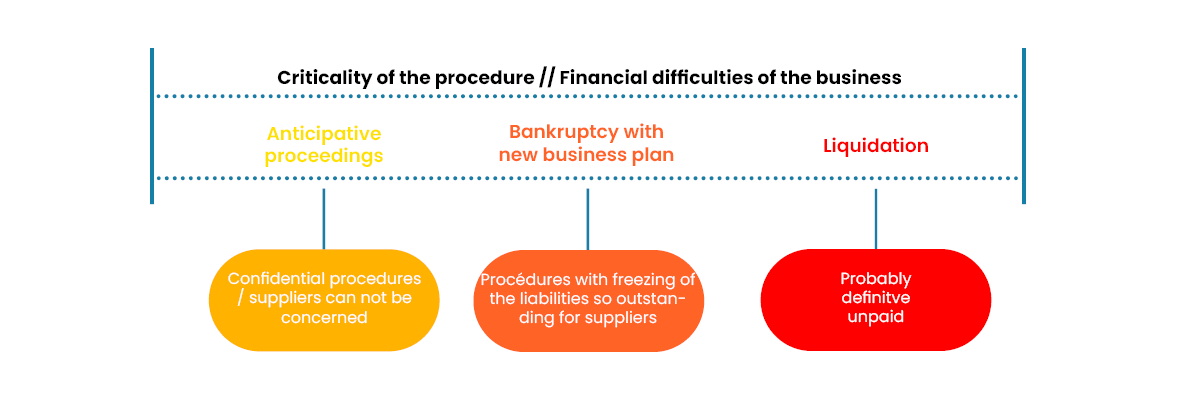
What changes when proceedings open?
Pre-opening debts
As a general rule, the opening judgment prohibits payment of most claims arising before proceedings and stops individual actions seeking payment. Holding an enforceable judgment does not automatically allow separate enforcement to continue.
New supplies and contracts
Claims arising after the opening judgment are not all treated alike. Certain qualifying claims benefit from priority payment; others may have to be declared. Never assume that every new invoice is automatically secured.
Existing contracts
The opening of proceedings does not automatically terminate every ongoing contract. Rules on continuation and payment apply; review deliveries, credit limits and the contractual position with legal advisers.
Security and guarantees
Retention of title, security interests, personal guarantees and credit insurance can materially change recovery prospects, but each has its own formalities and deadlines.
Declare your claim: the priority action
For most French pre-opening trade claims, the standard filing deadline is two months from publication of the opening judgment in the BODACC (the French official commercial announcements bulletin). An extended period generally applies to creditors established outside metropolitan France; special rules apply to certain secured creditors and other situations.
In safeguard or judicial reorganisation, the claim is normally sent to the court-appointed representative of creditors (mandataire judiciaire). In liquidation, it is sent to the liquidator. These are distinct from the judicial administrator, whose appointment and role concern management or supervision of the business.
| Step | Action for the credit manager | Why it matters |
|---|---|---|
| 1. Confirm the judgment | Check the BODACC notice, procedure type, opening date and appointed professional. | The publication triggers the ordinary declaration deadline. |
| 2. Reconcile the account | List unpaid invoices, credit notes, deposits, payments, interest and any unbilled deliveries. | The amount and basis of the claim must be defensible. |
| 3. Check protections | Identify retention-of-title clauses, security, guarantees, credit insurance and set-off issues. | Some rights require separate and rapid action. |
| 4. File the declaration | Submit the claim to the appropriate court-appointed professional with supporting evidence and retain proof of submission. | A late declaration can exclude the creditor from distributions unless relief is obtained. |
| 5. Monitor the case | Track claim verification, disputes, plans, asset sales and distributions. | Filing does not itself guarantee payment. |
| 6. Review future exposure | Coordinate sales, finance, logistics and legal teams before accepting new orders. | Prevents new losses while preserving appropriate commercial options. |
Important: a late declaration does not simply extinguish the underlying debt in every case. It can, however, prevent participation in the collective procedure. Relief from the deadline (relevé de forclusion) may be possible under strict conditions and within specific time limits. Do not rely on it as a normal fallback.
What information should the claim contain?
Amounts and dates
Amount due at the opening judgment, sums not yet due, maturity dates and, where relevant, the method for calculating interest that continues to accrue.
Evidence and legal position
Invoices, contracts, orders, delivery evidence, account statements, details of any security and information about existing disputes or proceedings.
The claim must reflect the actual legal position, not merely the balance shown in the accounting system. A disputed invoice, an unbilled delivery or a retention-of-title claim may require additional analysis.
How do proceedings evolve?
A judicial reorganisation may involve an observation period during which the court assesses whether the business can be rescued. Outcomes can include a continuation plan, a sale or liquidation. Liquidation can also be ordered immediately when rescue is manifestly impossible.
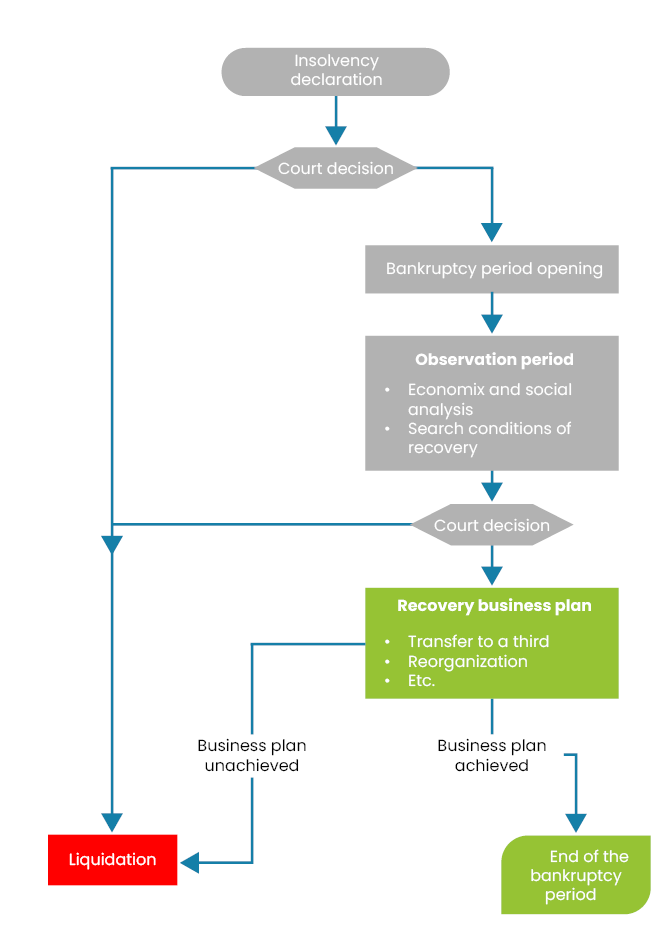
Payment under an approved plan can take years, and a plan can fail. In liquidation, recoveries depend on available assets, secured claims, statutory priorities and costs. It is therefore misleading to promise a universal recovery percentage or a fixed outcome.
The domino effect: why prevention matters
When one company fails, its suppliers may suffer serious cash shortages, especially where the unpaid balance represents a large share of turnover or available liquidity. Those suppliers may then delay payments to their own partners, transmitting financial stress along the supply chain.
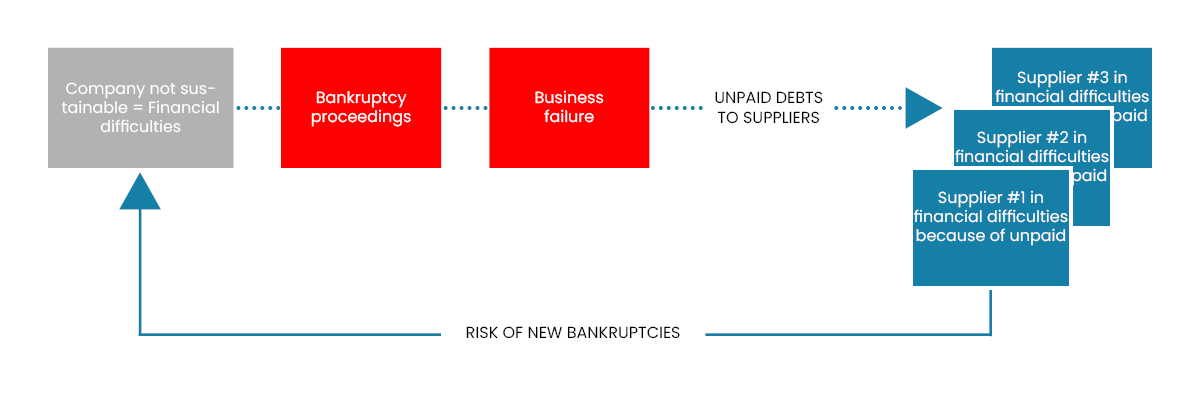
The lesson for credit managers is clear: the best response to insolvency starts before the opening judgment. Monitor financial deterioration, payment behaviour, exposure concentration, credit limits and insurance coverage. A customer that has historically paid on time may still become insolvent very quickly.
Practical checklist when a customer enters proceedings
- Identify the exact legal entity and verify the official opening notice.
- Stop inappropriate individual collection or enforcement actions concerning pre-opening debts.
- Secure all invoices, contracts, delivery documents and correspondence.
- Calculate the claim and verify security, title-retention rights and guarantees.
- File with the correct representative before the applicable deadline.
- Notify the credit insurer in accordance with the policy, where relevant.
- Decide how to handle open orders and any post-opening supplies.
- Track the proceedings, claim verification and possible distributions.
Conclusion: insolvency proceedings are a credit management issue
Once collective proceedings begin, the creditor's freedom to act is constrained and recovery may be uncertain. Speed, accurate records and a clear understanding of creditor rights are essential. Equally important is the preventive work carried out long before the customer reaches this stage.
The objective is not simply to submit a claim correctly. It is to minimise losses, protect future business and avoid the domino effect of customer failures.
Legal scope: this guide describes the main French corporate insolvency procedures. It is not a substitute for advice on a specific case, particularly where cross-border insolvency, guarantees, secured claims or title-retention rights are involved.
Official resources: BODACC · Justice.fr: declaring a claim · Infogreffe.