Outsourcing unpaid invoices to a collection agency can be useful when internal reminders have failed. But handing over a receivable does not guarantee recovery. The decision should depend on the debtor, the evidence available, the likely recovery amount and the real economics of the assignment.
When should you use a collection agency?
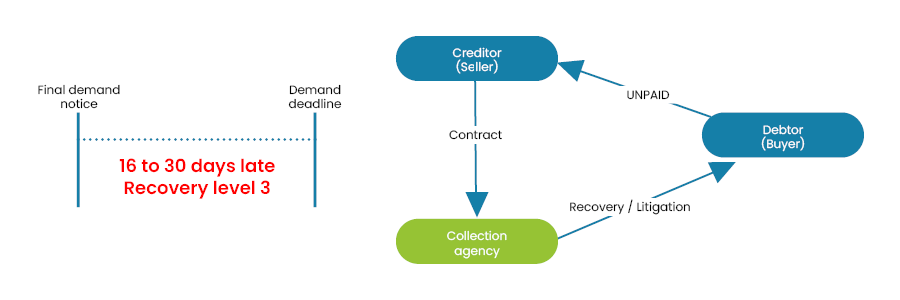
After several unsuccessful reminders and a formal demand, a creditor may decide to entrust a case to an external debt collection specialist. This is one option, not an automatic step: direct negotiation, a lawyer, a court procedure or a credit insurer may be more appropriate depending on the circumstances.
Lack of internal capacity
A specialist can take over difficult files while the credit management team concentrates on its active portfolio.
Local expertise
For cross-border receivables, an agency with genuine local experience may help with language, debtor tracing and procedures.
Escalation
Contact from a third party may encourage a debtor to respond when previous internal communications have failed.
What are the advantages and disadvantages?
| Potential advantages | Important limitations |
|---|---|
| Experienced collectors and structured follow-up | Quality varies considerably between agencies and individual collectors. |
| Reduced internal workload | Preparing and monitoring a case still requires time and reliable data. |
| Potentially useful third-party intervention | The customer relationship may deteriorate if communication is poorly managed. |
| Access to local or specialist resources | Legal action, enforcement and cross-border recovery may involve additional providers and fees. |
| Contingency-based remuneration may limit upfront costs | The provider may deprioritize difficult, low-value or unprofitable cases. |
A collection agency is a commercial business with its own profitability constraints. Its incentives are not necessarily identical to those of the creditor. A file that is economically unattractive for the agency may still justify action from the creditor's perspective, for example because of its strategic importance or the risk of setting an undesirable precedent.
How are collection agencies paid?
Success fee
A percentage of recovered sums. Check how the fee applies to partial payments, instalments and payments made directly to you.
Fixed fee
A fee per case or action. Costs are more predictable but may be incurred without any recovery.
Hybrid model
An initial fee plus a recovery commission, sometimes with separate charges for legal escalation.
Do not compare agencies on headline commission alone. Assess the net amount actually recovered after all fees, the time taken, the level of reporting and the quality of debtor treatment. In France, costs of amicable recovery are generally borne by the creditor unless a legal exception applies; an agency cannot simply charge all its fees to the debtor. Statutory late-payment interest and recovery-cost compensation follow their own rules.
What should you check before outsourcing a case?
1. Is the receivable genuinely due?
Confirm the contractual due date, invoice, delivery evidence, customer identity and any existing dispute. An unresolved commercial dispute cannot be solved by more aggressive reminders.
2. Is the debtor able to pay?
Review recent payment behavior, financial distress indicators, insolvency proceedings and any credit insurance coverage.
3. What is the recovery strategy?
Agree on contact methods, escalation thresholds, authority to negotiate discounts or payment plans, and the conditions for legal action.
4. How will results be measured?
Require clear case statuses, dated actions, payment allocation, reporting frequency and an auditable record of costs.
Choosing a collection agency: six essential criteria
- Relevant experience: B2B rather than consumer collections, your industry, invoice sizes and the countries concerned.
- Transparent pricing: written definitions of commission, disbursements, legal fees, termination and treatment of direct payments.
- Compliance: applicable registration and professional rules, data protection, confidentiality and appropriate conduct toward debtors.
- Operational transparency: access to the history of actions, case-by-case explanations and regular reporting.
- Control: the creditor retains clear authority over settlement proposals, write-offs and escalation to litigation.
- Performance: compare comparable portfolios, not just the agency's advertised overall recovery rate.
In France, amicable debt collection on behalf of others is subject to specific requirements under the Code of Civil Enforcement Procedures. The precise requirements depend on the activities carried out. International assignments must also be checked against local rules: an agency authorized in one country is not automatically entitled to carry out every activity elsewhere.
How to evaluate real performance
| Indicator | Why it matters |
|---|---|
| Net recovery rate | Cash recovered after agency fees, relative to the value assigned. |
| Time to recovery | Measures how quickly funds are returned to the creditor. |
| Recovery rate by case age and value | Avoids misleading comparisons between easy and difficult portfolios. |
| Cost per recovered euro | Shows the true economics of outsourcing. |
| Case resolution quality | Distinguishes payment, justified dispute, insolvency and unsuccessful closure. |
Illustrative example: an agency recovers EUR 30,000 from EUR 100,000 assigned and charges a 15% success fee. The gross recovery rate is 30%, but the net cash received before other expenses is EUR 25,500. Whether this is satisfactory depends on the age and quality of the cases, alternative costs and the likely result without outsourcing.
Collection agency, lawyer or credit insurer?
An agency may be well suited to a portfolio of overdue but legally straightforward invoices. A lawyer or appropriate judicial professional may be preferable where a claim is contested, urgent protective action is needed or enforcement is contemplated. If the receivable is insured, the creditor must respect the policy's reporting deadlines and instructions before assigning or pursuing the debt. Otherwise, insurance coverage may be affected.
In every case, the creditor should retain a consolidated view of the receivable and its history. Transferring a file must not mean losing visibility or responsibility for the customer relationship.
Conclusion: outsource execution, not judgment
Collection agencies can provide valuable resources and expertise. They can also be costly, insufficiently transparent or economically reluctant to pursue the most difficult cases. The decision to outsource should therefore be a deliberate credit management decision, supported by a clear mandate and measurable objectives.
The best recovery strategy is not necessarily the one that generates the most reminders or transfers the most files. It is the one that resolves the underlying problem and maximizes net recovery while controlling costs, risks and commercial consequences.
Related reading: How to manage unpaid receivables and bad debts.