Down Payments and Payments in Advance: How to Secure B2B Sales
Requesting payment before delivery is one of the most effective ways to reduce customer credit exposure and improve cash flow. The right approach depends on the transaction, your customer's financial position and the balance of commercial interests.
Payment in advance versus down payment
With full payment in advance, the buyer pays the entire agreed price before the goods are delivered or the service is performed. This substantially reduces the seller's risk of non-payment for that transaction, provided the funds have actually been received and are not subject to reversal or dispute.
With a down payment, the buyer pays only part of the price upfront. The remaining balance is payable according to the agreed milestones or payment terms. This approach shares the financing effort between the parties and reduces, but does not eliminate, the seller's credit exposure.
| Criteria | Full payment in advance | Down payment |
|---|---|---|
| Amount paid before delivery | 100% of the agreed price | An agreed percentage or fixed amount |
| Seller's remaining credit exposure | Generally very limited for the paid transaction | Outstanding balance remains exposed |
| Buyer's cash commitment | High | Lower and negotiable |
| Typical use | High-risk customers, first orders, bespoke goods | Projects, large orders, custom production, risk-sharing |
Both methods can reduce the seller's required credit limit and working capital needs. However, payment conditions must remain commercially acceptable and comply with the contract and applicable law.
How full payment in advance works
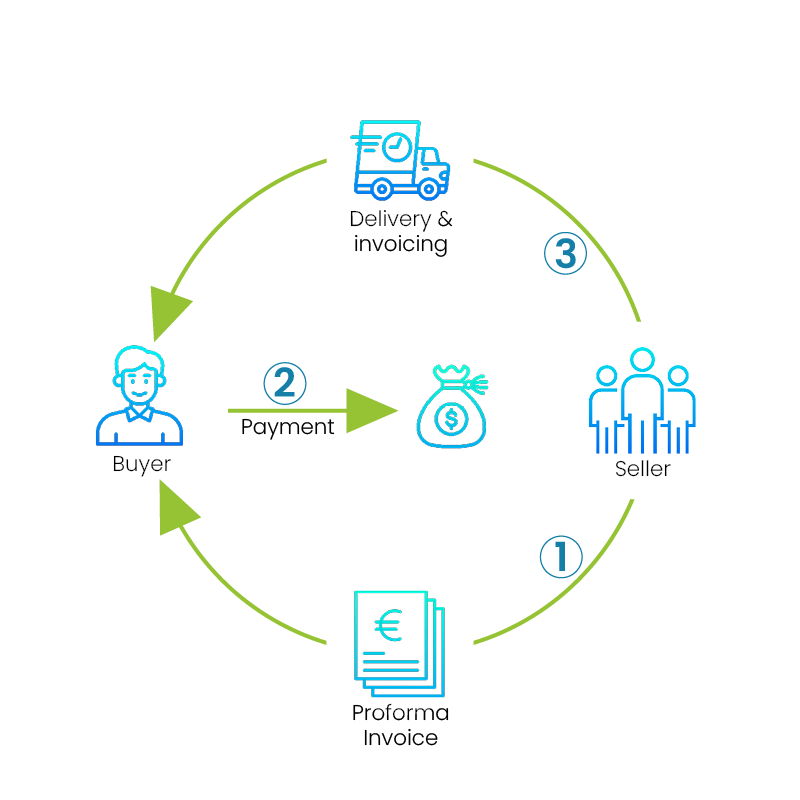
- Agree on the payment conditions. State the amount, currency, due date and delivery conditions in the quotation, purchase order or contract.
- Issue a proforma invoice when appropriate. A proforma invoice communicates the commercial details and payment instructions; it is not necessarily a substitute for the tax invoice required under local rules.
- Receive and verify the funds. Confirm that payment has been credited before releasing goods or starting work when this is a contractual condition.
- Deliver and issue the required invoice. Follow the applicable invoicing and tax rules, including any requirements for advance-payment invoices or VAT.
How to negotiate a down payment
A down payment is often easier for a customer to accept than full prepayment. Depending on the order and industry, an advance of 20% to 50% may be negotiated, but there is no universal percentage. The appropriate amount should reflect production costs, commercial leverage, financial risk and the residual credit limit.
Consider asking for a down payment when the customer is new, the order is unusually large, the goods are made to order or the buyer's financial position is uncertain. Payment milestones can also be linked to objective project events, such as order confirmation, completion of production or acceptance of delivery.
Receiving the initial payment on time is a useful behavioural signal, but it does not prove that the buyer will be able to settle the remaining balance. Continue monitoring payment behaviour and financial information throughout the contract.
Protecting the buyer with an advance payment guarantee
From the buyer's perspective, paying before delivery creates a different risk: the seller might fail to perform or become insolvent. An advance payment guarantee issued by a bank may help address that concern.
Under the agreed terms, the guarantor may be required to reimburse the buyer if specified obligations are not fulfilled. The scope, expiry date, documentary requirements and conditions for making a claim are essential. A first-demand guarantee and a conditional guarantee do not offer identical protection.
The guarantee should be reviewed carefully, especially for international transactions. Its cost and administrative requirements should also be included in the commercial negotiation. For a broader discussion, see Bank Guarantees.
Practical example: reducing exposure on a large order
A supplier accepts an order worth EUR 100,000. Rather than granting credit for the entire amount, the parties agree on a 30% down payment, with the remaining 70% due 30 days after delivery.
| Payment component | Amount |
|---|---|
| Down payment before production | EUR 30,000 |
| Remaining amount due after delivery | EUR 70,000 |
| Total order value | EUR 100,000 |
The down payment reduces the amount financed by the supplier by EUR 30,000 compared with selling the entire order on credit. It does not automatically make the remaining EUR 70,000 safe: the seller must still assess the buyer's creditworthiness and monitor the due date.
Good practices for credit managers
- Include prepayment and down-payment options in the credit policy and commercial terms.
- Agree in writing on payment milestones, invoicing, delivery and the consequences of cancellation.
- Check receipt of funds rather than relying solely on a payment confirmation supplied by the buyer.
- Reassess the outstanding balance against the approved customer credit limit.
- Use guarantees where appropriate to address the buyer's concerns about advance payment.
- Coordinate with sales, finance and operations so that payment conditions are applied consistently.

