Working Capital Requirement (WCR) is often one of the largest sources of cash that a company can unlock without increasing sales or raising new financing. Yet improving WCR requires more than calculating a balance-sheet ratio: it requires management commitment, reliable indicators and changes to the operational processes that generate inventories, receivables and payables.
WCR is a genuine cash trap when commercial, purchasing, production and billing decisions are made without considering their financing consequences. Conversely, a well-managed operating cycle can release cash, reduce financing costs and improve profitability.
What does it mean to manage working capital?
Working capital management combines two complementary disciplines: measuring WCR precisely and acting on the processes responsible for it. Tracking a number alone does not improve cash flow. The real challenge is to understand why the number changes and who can influence it.
Measure
- Calculate WCR monthly, or quarterly where appropriate
- Break down inventories, receivables and payables
- Monitor amounts and days of sales
- Compare actuals with budgets, trends and operational targets
Act
- Identify root causes, not just symptoms
- Assign each action to an operational owner
- Prioritise changes by cash impact and feasibility
- Measure realised cash benefits and adjust the plan
Calculate and monitor the components of WCR
For the operating cycle, a simplified formula is:
A more complete analysis includes other operating assets and liabilities such as advances, tax-related operating balances and accrued expenses, depending on the company's accounting framework. Use a consistent scope over time to make comparisons meaningful.
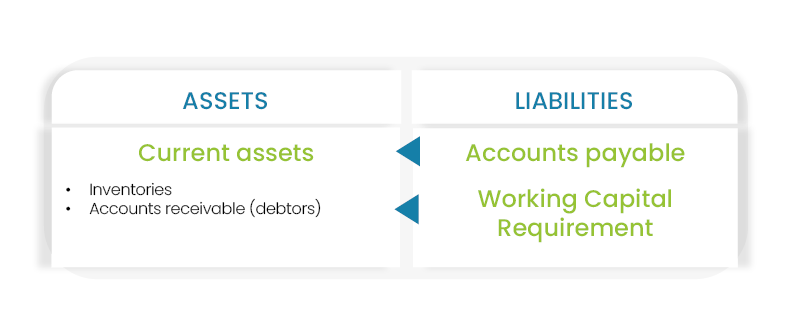
For effective monitoring, distinguish the following items rather than relying on a single total:
| Component | What to track | Operational questions |
|---|---|---|
| Raw materials | Inventory value and days of consumption | Are purchasing quantities, lead times and safety stocks appropriate? |
| Work in progress | Production WIP and cycle time | Where do bottlenecks and unfinished orders immobilise cash? |
| Finished goods | Inventory value, ageing and turnover | Do production and demand forecasts match? |
| Trade receivables | Outstanding balance including VAT where applicable, overdue amounts, DSO, disputes | Are payment terms, billing quality and collection processes effective? |
| Trade payables | Outstanding balance including VAT where applicable, due dates and DPO | Are payment terms negotiated and respected without damaging supplier relationships? |
Inventories are generally measured at their accounting cost, while trade receivables and payables are generally recorded including applicable VAT. When converting balances into days, denominators must match the underlying accounting scope: receivables and sales, payables and purchases, and inventories and their relevant cost flows. A days-of-sales presentation of the total WCR is useful for overall steering but does not replace DSO, DIO and DPO.
Track WCR in value and in days
WCR in currency measures the amount of cash tied up in the operating cycle. WCR expressed in days of sales helps interpret changes in relation to business volume.
WCR in days of sales = WCR / Annual sales excluding VAT × 365
Use a consistent period and annualised sales where appropriate. For businesses with substantial seasonality, a rolling 12-month denominator and monthly balance trends are often more informative than a single year-end snapshot.
Example. A company has €2.4 million in inventories, €3.2 million in receivables and €1.8 million in payables. Its operating WCR is €3.8 million. With annual sales of €36.5 million excluding VAT, WCR represents 38 days of sales.
If WCR decreases to €3.3 million while sales remain stable, the company releases €500,000 in cash. The improvement is real only if it reflects sustainable changes rather than delayed supplier payments, one-off transactions or a seasonal effect.
Build a monthly WCR dashboard
Monthly monitoring is generally preferable to quarterly reviews because it allows teams to detect deteriorations earlier and connect them to operational events. A useful dashboard should show at least the current month, the previous month, the same month last year, the budget and the target.
| Indicator | Example target | Owner | Action if off target |
|---|---|---|---|
| WCR (€ and days of sales) | Reduce by 3 days | CFO / finance | Investigate changes by component |
| Inventory days (DIO) | Reduce by 4 days | Operations / supply chain | Review forecasts, slow-moving items and production cycles |
| Days Sales Outstanding (DSO) | Reduce by 5 days | Credit management | Analyse terms, invoice quality, disputes and collection priorities |
| Days Payable Outstanding (DPO) | Within agreed terms | Purchasing / accounts payable | Review purchasing terms and payment scheduling |
| Overdue receivables and dispute ageing | Downward trend | Credit management / sales | Address root causes and assign resolution owners |
Targets above are illustrative. They must be adapted to the sector, the company's operating model, its contracts and applicable payment-term regulations.
Turn the dashboard into an action plan
WCR optimisation is cross-functional by nature. Finance can measure and coordinate it, but the levers belong to purchasing, production, logistics, sales, customer service, billing and credit management.
- Diagnose. Break down the WCR by entity, business unit, product line, customer segment and supplier category where data allows.
- Identify causes. Distinguish structural factors (business model, payment terms, manufacturing cycle) from avoidable inefficiencies (late invoicing, disputes, excess stocks, slow approvals).
- Quantify opportunities. Estimate the potential cash release from each initiative using the appropriate turnover or cost base.
- Assign accountability. Give each action a named owner, a deadline and a measurable indicator.
- Review monthly. Compare cash actually released with expected benefits, investigate deviations and revise priorities.
Quantify the cash impact of operational improvements
A reduction of five days in a KPI does not always release the same amount of cash. The result depends on the relevant daily flow.
| Improvement | Simplified cash effect | Illustrative example |
|---|---|---|
| DSO decreases by 5 days | 5 × daily credit sales on a consistent receivables basis | At €100,000 per day, approximately €500,000 released |
| Inventory holding decreases by 5 days | 5 × daily relevant cost of sales or consumption | At €60,000 per day, approximately €300,000 released |
| DPO increases by 5 days | 5 × daily relevant purchases | At €50,000 per day, approximately €250,000 temporarily financed by suppliers |
These are simplified, independent scenarios. The effect of VAT, sales mix, seasonality, payment schedules and changes in business volume must be considered in a detailed forecast. Extending supplier payment terms must remain compliant with contracts and applicable law; systematically paying suppliers late is not a sound WCR strategy.
Why credit management is central to WCR performance
Receivables are not generated only by collection teams. They are influenced by commercial terms, customer onboarding, order management, proof of delivery, invoicing accuracy, dispute handling and payment methods. This is why credit management must operate across the full Quote-to-Cash process.
Connected ERP, CRM, billing and credit management data make it easier to identify the real causes of delays. Automation and AI can assist with information processing, customer responses, cash forecasting and action prioritisation, but technology must support professional expertise, data interconnection and functional quality. Sending more reminders is not necessarily equivalent to collecting more cash.
See also AI: What If We Talk About Credit Management Again? for a broader discussion of digital performance.
Common mistakes when managing WCR
- Looking only at year-end balances: seasonal peaks and recurring problems may be hidden.
- Confusing growth with deterioration: a higher WCR amount may result from higher sales even when efficiency is stable.
- Mixing incompatible denominators: receivables, inventories and payables do not all use the same underlying flow.
- Reducing payables by paying late: this can create legal, supply and reputational risks.
- Optimising one KPI in isolation: excessively low inventories may disrupt service; overly restrictive credit terms may damage sales.
- Reporting without action: dashboards only create value when operational teams act on their findings.
From WCR monitoring to sustainable improvement
The purpose of working capital management is not simply to produce a monthly calculation. It is to build a company-wide discipline that continually challenges the processes consuming cash. Each improvement should be linked to a business decision, an accountable team and a measurable financial outcome.
The next step is to turn these findings into practical measures: improve the working capital.
