An order for payment can be an efficient way to recover an unpaid invoice when the claim is sufficiently documented and the debtor is unlikely to dispute it. It is not, however, a guarantee of payment. The creditor must choose the appropriate procedure, respect notification deadlines and assess whether the debtor can actually pay.
Two distinct mechanisms are presented here: the French injunction to pay (injonction de payer) and the European Order for Payment for qualifying cross-border claims. Their deadlines and procedural requirements must not be confused.
What is an order for payment?
An order for payment allows a creditor to request a judicial decision based initially on a written application, without an ordinary adversarial hearing at that first stage. It is especially useful for an unpaid, due and well-documented monetary claim.
Simple initial application
The court examines the creditor's application and supporting information without initially hearing both parties.
Strong payment incentive
Formal service of a judicial order may prompt a debtor to settle an invoice previously ignored.
Risk of opposition
If the debtor contests the order, the dispute may move into ordinary court proceedings.
The key question is not simply whether the invoice is overdue. It is whether the creditor has a sufficiently strong file and whether an order will result in actual recovery.
The French injunction to pay (injonction de payer)
In France, a commercial creditor can apply to the competent court for an injunction to pay. For commercial debts this is generally the commercial court (tribunal de commerce), with specific arrangements in Alsace-Moselle. The court may grant all or part of the request, or reject it.
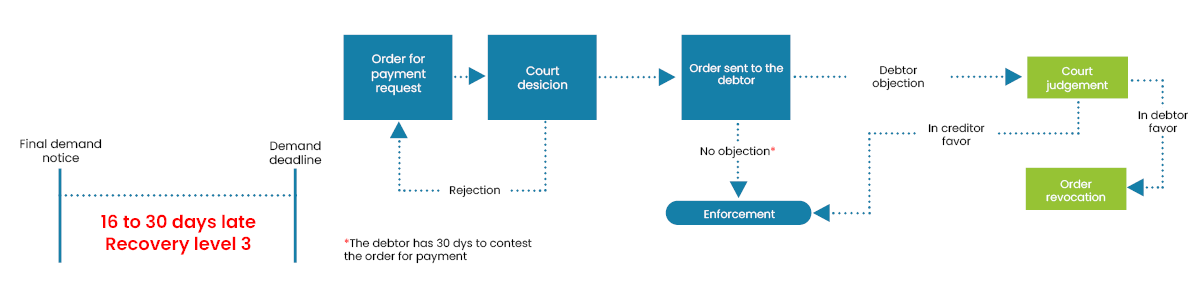
The procedure in five stages
1. Prepare the application
Identify the debtor, quantify the claim and assemble the contract, purchase order, invoices, proof of delivery or service, payment reminders and any acknowledgement of the debt.
2. Apply to the competent court
Submit the appropriate application and supporting documents. The judge examines the file without an initial hearing and may issue an order for all or part of the claim.
3. Serve the order
For orders issued on or after 1 September 2026, service must occur within three months of the order. Earlier orders were subject to a six-month period. Service is carried out by a commissaire de justice.
4. Allow for opposition
The debtor generally has one month after service to oppose the order. Special starting-point rules can apply where service was not made personally. Opposition leads to an adversarial examination of the claim.
5. Enforce the order if appropriate
In the absence of timely opposition, the creditor can obtain the relevant confirmation of enforceability and, if voluntary payment is still not made, instruct a commissaire de justice to undertake enforcement measures. An enforceable order does not ensure that assets will be available.
Important: a rejection does not prevent the creditor from bringing an ordinary claim. Where the judge grants only part of the requested amount, the consequences of accepting and serving the partial order should be considered carefully before proceeding.
The European Order for Payment
Regulation (EC) No 1896/2006 established a uniform European Order for Payment procedure for qualifying cross-border civil and commercial monetary claims. It applies across participating EU Member States, excluding Denmark. It is not a universal mechanism for claims against customers anywhere in Europe or worldwide.
Application
Use standard Form A and identify the parties, the amount claimed, the basis of the claim and the evidence supporting it. Jurisdiction must be established under the applicable rules.
Court examination
The court examines the application and may request correction or completion. The regulation provides for an order to be issued normally within 30 days of a complete application, but this is not a guaranteed turnaround.
Opposition
The defendant may oppose the order within 30 days of service, without having to explain the grounds. Proceedings may then continue under the applicable rules unless the claimant has requested otherwise.
Cross-border enforcement
If no timely opposition is lodged, the order may be declared enforceable and recognised in other participating Member States without an additional declaration of enforceability. Enforcement itself follows the law of the enforcing state.
The European procedure uses standard forms, including Form A for the application and Form F for opposition. Official information and forms are available on the European e-Justice Portal.
French or European order for payment: which should you choose?
| Criterion | French injunction to pay | European Order for Payment |
|---|---|---|
| Typical scope | Claims under French court jurisdiction, including domestic commercial debts | Qualifying cross-border civil and commercial claims in participating EU countries |
| Initial examination | Written application without an initial adversarial hearing | Standardised application without an initial adversarial hearing |
| Service / notification | Service by a commissaire de justice; three-month deadline for orders issued from 1 September 2026 | Service according to the applicable national rules and EU minimum standards |
| Opposition period | Generally one month, subject to rules on service | 30 days from service |
| Enforcement | Under French enforcement rules | Recognised in participating EU states; local enforcement rules apply |
How to make an order for payment effective
The order for payment has a real psychological impact. A debtor who has ignored routine reminders may react when formally served with a court order. This is particularly true when non-payment results from inertia or deliberate delay rather than a genuine dispute.
But the procedure is less attractive when the debtor has a credible contractual objection, when the documentation is weak, or when the business is insolvent. A well-founded opposition can turn a supposedly simple procedure into a longer and more expensive dispute.
Before applying
- Check that the claim is due and accurately calculated.
- Confirm the debtor's legal identity and address.
- Resolve or document any commercial dispute.
- Check solvency and insolvency proceedings.
- Compare expected recovery with procedural and enforcement costs.
After obtaining an order
- Track the service deadline immediately.
- Monitor the opposition period.
- Respond quickly if the debtor offers payment.
- Keep evidence and communications organised.
- Assess whether enforcement will actually produce cash.
What does the procedure cost?
There is no reliable single flat price of EUR 40 for the entire process. Costs can include court fees, service by a commissaire de justice, legal representation where required and enforcement charges. The amount depends on the jurisdiction, the claim, the debtor's response and the steps undertaken. Request a current estimate before initiating proceedings.
What if the debtor opposes the order?
Opposition is not automatically proof that the creditor's claim is unfounded. It does, however, remove the main procedural advantage: the dispute may have to be examined through ordinary proceedings. That is why a credit manager should assess the probability of opposition before choosing this route.
Conclusion: a court order is a means, not the objective
For a clear, overdue and documented claim, an order for payment can be a cost-effective route from amicable collection to enforceable recovery. The French and European procedures are useful but distinct, and their deadlines must be respected.
The objective is not to obtain a court order. It is to recover the receivable. Choosing the right procedure requires legal accuracy, sound documentation and a realistic assessment of the debtor's ability to pay.
Related guides: Court summons for payment and Interim payment order (référé-provision).
Legal sources: French government guidance (updated September 2026); Regulation (EC) No 1896/2006; European e-Justice Portal.
