A documentary credit is one of the most effective ways to secure payment in international trade, provided that the banks are reliable, the terms are properly negotiated and the documents presented comply with the credit. For a Credit Manager, the key question is not simply whether a documentary credit exists. It is whether its terms genuinely protect the exporter and can be fulfilled in practice. A documentary credit (often called a letter of credit or LC) is an undertaking by an issuing bank to honour a complying presentation of documents under the terms of the credit. It is commonly used in international trade to reconcile the exporter’s need for payment security with the importer’s wish to pay against evidence of shipment or other agreed documentary conditions. Most modern commercial documentary credits are subject to the Uniform Customs and Practice for Documentary Credits (UCP 600), published by the International Chamber of Commerce, when expressly incorporated into the credit. Documentary credits are independent of the underlying sales contract. This separation is essential: the seller must meet the documentary requirements even when the commercial transaction has otherwise been performed correctly. The advising bank and confirming bank may be the same institution, but advising a credit is not the same as confirming it. Under UCP 600, a documentary credit is irrevocable even if it does not expressly say so. A credit cannot normally be amended or cancelled without the agreement of the issuing bank, any confirming bank and the beneficiary. The old distinction between revocable and irrevocable documentary credits should not be presented as three current standard categories. A confirmed documentary credit is often preferable when the issuing bank’s credit quality, political environment or transfer restrictions raise concerns. However, confirmation does not protect the seller against its own documentary discrepancies or every possible legal or sanctions-related obstacle. A documentary credit may be available by: Deferred-payment and acceptance credits can sometimes be financed or discounted, depending on the bank, the transaction and the applicable terms. There is no universal two-to-seven-day payment guarantee: timing depends on presentation, examination, availability, maturity and banking arrangements. The most important work takes place before the goods are shipped. The Credit Manager should review the draft credit alongside sales, logistics and the banking partner. For example, a seller may deliver goods correctly but remain unable to present documents if the credit requires a buyer-issued certificate that the buyer refuses to sign. The documentary credit then offers much less practical security than expected. Remember that the sales contract, documentary credit and transport arrangements are legally distinct, even though they must be operationally consistent. Costs can include issuance, advising, confirmation, amendment, document examination, negotiation and discrepancy fees. Confirmation pricing depends on the issuing bank, country risk, amount, tenor and market conditions. Rather than relying on a fixed percentage, obtain a transaction-specific quote and compare the cost with the credit exposure being secured. Transferable credit: a credit expressly designated as transferable may be transferred to one or more second beneficiaries under the conditions of UCP 600. It can help intermediaries finance purchases from their suppliers. Back-to-back credit: a separate documentary credit is issued in favour of a supplier, supported commercially by an incoming credit. The two credits remain distinct undertakings, and the intermediary must manage differences in amounts, dates and documents. A documentary credit can significantly reduce export payment risk, but its value lies in the quality of the bank commitments and the feasibility of the documentary conditions, not in the label alone. Choose the issuing bank carefully, seek confirmation when justified, negotiate documents that your business can actually produce and check the credit before shipment. These decisions matter more than any generic claim that a documentary credit makes payment automatic. Continue with the related tutorials: The letter of credit, Assessing export customers and Managing export credit risk.The Documentary Credit: How to Secure International Trade Payments
What is a documentary credit?
Who is involved?
Participant
Role
Applicant
The buyer or importer who requests issuance of the credit.
Issuing bank
The buyer’s bank, which undertakes to honour a complying presentation.
Beneficiary
The seller or exporter in whose favour the credit is issued.
Advising bank
Authenticates and advises the credit to the beneficiary, without automatically undertaking to pay.
Confirming bank
Adds its own independent undertaking to honour or negotiate a complying presentation, when it agrees to confirm the credit.
Advised or confirmed: which level of protection?
Structure
Bank commitment
Main consideration for the exporter
Irrevocable, advised but unconfirmed
The issuing bank is committed; the advising bank does not add a payment undertaking.
Assess the issuing bank and the country in which payment must be made.
Irrevocable and confirmed
The confirming bank adds its own undertaking, subject to a complying presentation.
Reduces dependence on the issuing bank and may mitigate certain country and transfer risks, subject to the confirmation’s terms.
How does a documentary credit work?
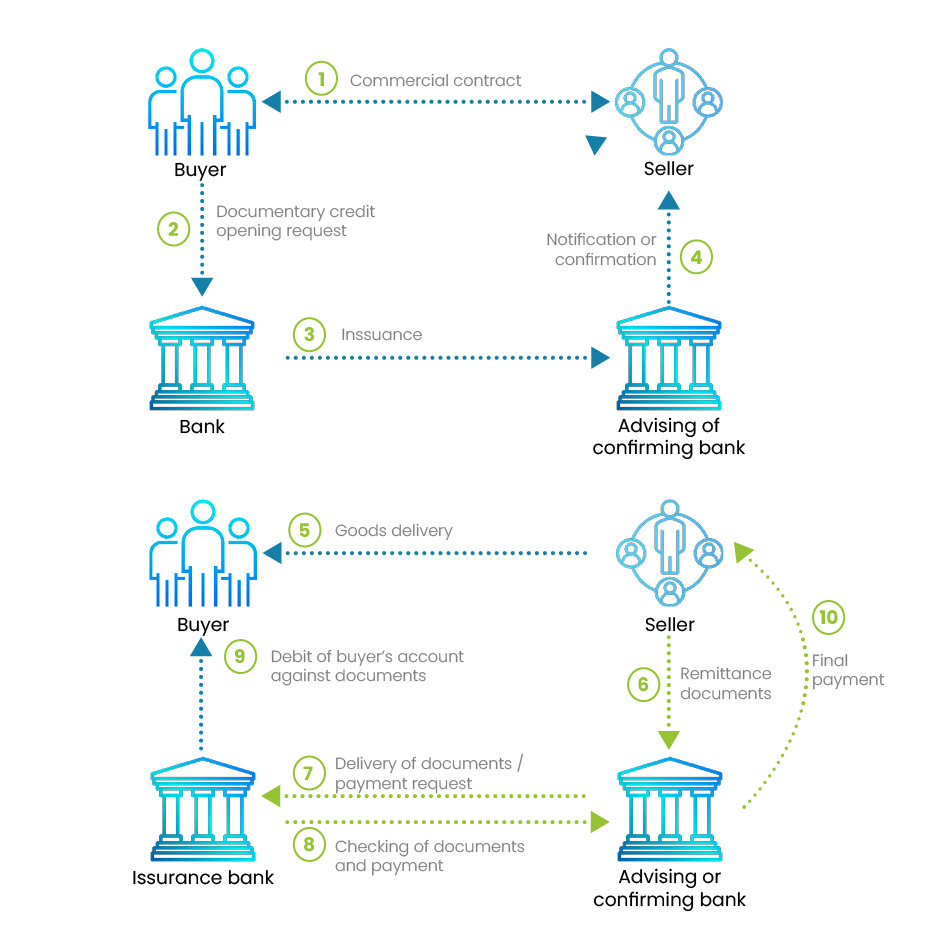
When does the exporter receive payment?
How to negotiate a documentary credit effectively
Item to verify
Practical question
Issuing bank and confirmation
Is the issuing bank acceptable? Is confirmation needed, available and correctly worded?
Amount and currency
Does the credit cover the agreed price, currency and any permitted tolerances?
Expiry and presentation period
Is there enough time to ship, obtain documents and present them?
Shipment conditions
Are partial shipments, transhipment and the latest shipment date compatible with operations?
Required documents
Can the exporter obtain each document in exactly the required form?
Incoterm
Is the agreed Incoterm consistent with the transport, insurance and documentary requirements?
Payment availability
Is payment at sight or deferred? Which bank is nominated to honour or negotiate?
Bank charges
Who pays issuance, confirmation, amendment and discrepancy fees?
What does a documentary credit cost?
Special structures
The Credit Manager’s conclusion

What Is Credit Management? Role, Principles and KPIs
What is credit management? Credit management is the coordinated management of customer credit risk, payment terms, invoicing, disputes and receivables to support sales while protecting cash...
My DSO Manager presentation, collection and credit management software
My DSO Manager is a SaaS platform dedicated to credit management, cash collection and customer risk management. Designed by credit management professionals, it brings together the...
Balance Sheet Ratios: Formulas, Examples & Credit Risk
Key Balance Sheet Ratios: How to Calculate and Interpret Them Balance sheet ratios help credit managers assess a customer's financial resilience, short-term liquidity and ability to meet payment...