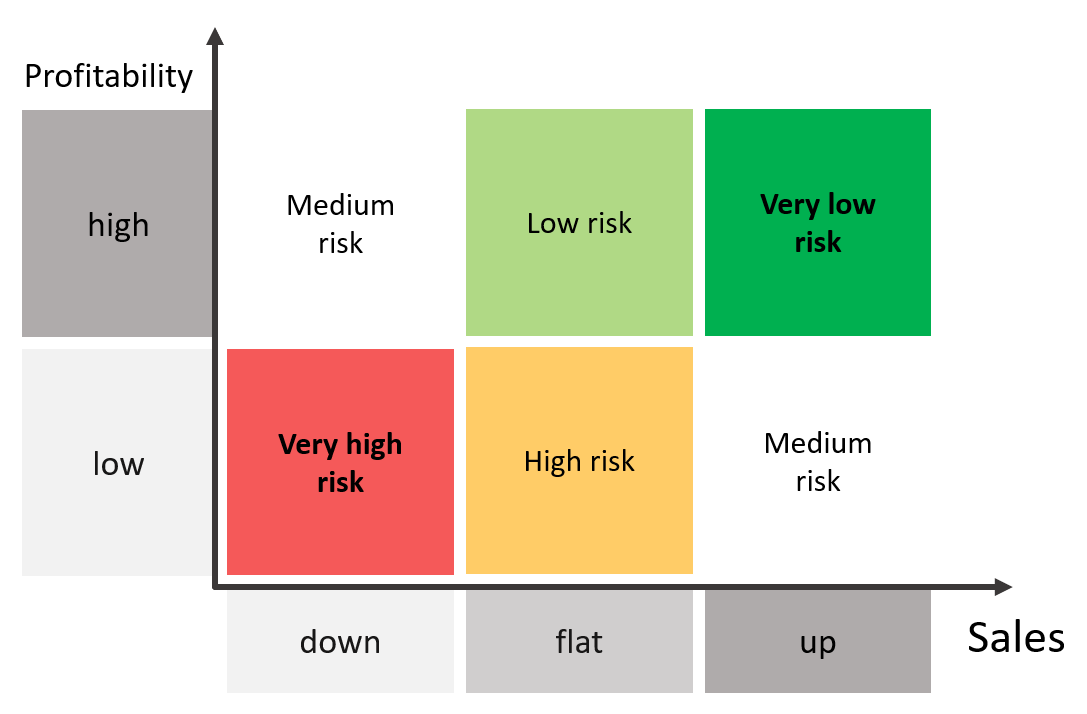
A practical guide to understanding a customer's revenue, profitability and financial resilience before making a credit decision. Financial statement analysis is a cornerstone of customer creditworthiness assessment. It combines financial techniques with business judgement: the aim is not to calculate every possible ratio, but to identify the factors that affect a customer's ability to pay its suppliers. Begin with the income statement (also called the profit and loss statement, or P&L) and the balance sheet. Review their main components and, whenever possible, compare at least three financial years. The P&L reports the revenue earned and expenses recognised over an accounting period, usually a financial year. The difference between income and expenses produces a net profit or loss. Unlike the balance sheet, which describes a company's position at a particular date, the P&L measures performance over time. Examine the direction and consistency of sales, operating profit and net income over the last three years, where the figures are available. Revenue growth is not automatically a sign of financial strength: expansion can increase inventories and receivables faster than the business can finance them. Conversely, falling revenue is a warning signal but does not necessarily lead to immediate cash pressure. A contraction in activity may temporarily release working capital, depending on the company's cost structure and payment terms. Intermediate measures help identify where profit is generated or lost. Definitions vary by accounting framework and industry; use consistent definitions when comparing companies or years. Investigate large year-on-year changes, margin deterioration, exceptional gains and unusual accounting estimates. An apparently strong net profit can conceal weakening underlying operations; a reported loss can sometimes arise from a one-off charge despite a viable core business. A common simplified measure of internal financing capacity starts with net income, adds non-cash depreciation and provision expenses, and subtracts relevant non-cash reversals. However, the precise calculation of cash flow from operations or cash flow available for investment and debt repayment requires additional adjustments, including changes in working capital and, depending on the measure, interest and tax cash flows. Why it matters: a profitable customer may still face payment difficulties if receivables are collected slowly, inventories build up, or significant debt repayments fall due. Review the cash flow statement where available, alongside the balance sheet and payment behaviour. The income statement reveals a customer's commercial development, profitability and capacity to generate earnings. It is a vital starting point, but it must be interpreted together with the company's financial structure, working capital requirements, liquidity and payment history. Continue the assessment with the balance sheet analysis tutorial (verify this destination in the CMS before publishing).How to Analyse a Profit and Loss Statement
Understanding the profit and loss statement
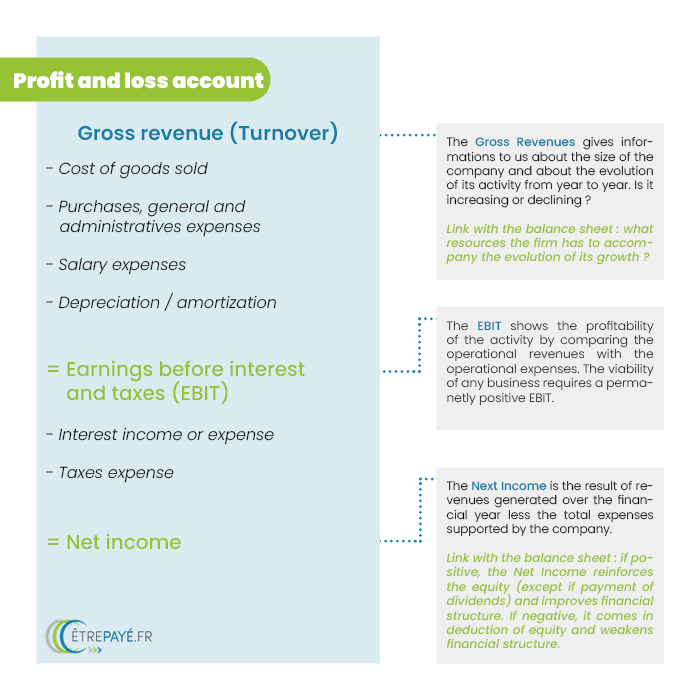
Compare revenue and profitability over time
Analyse the main income statement measures
Measure
Typical calculation or definition
What it tells the credit analyst
Gross profit / gross margin
Revenue minus cost of goods sold; gross margin is gross profit divided by revenue.
Pricing power and direct production or purchasing costs.
Value added
Output or sales less externally purchased goods and services, according to the reporting framework.
Value created by the business before distribution to employees, government and capital providers.
EBITDA
Earnings before interest, taxes, depreciation and amortisation.
Operating earnings before financing costs and non-cash depreciation or amortisation; not equivalent to cash flow.
Operating profit (EBIT)
Operating income minus operating expenses, including depreciation and amortisation.
Profitability of operations after the consumption of fixed assets.
Net finance result
Finance income minus finance costs.
Impact of debt servicing and other financial items; persistent high costs merit further analysis.
Profit before tax
Profit after operating and finance items, before income tax, subject to the reporting framework.
Overall earnings before tax.
Non-recurring items
Material unusual or non-recurring gains and losses disclosed in the accounts.
Whether reported earnings are sustainable. Presentation differs under IFRS and local GAAP.
Net profit or loss
Total recognised income minus expenses and tax for the period.
Bottom-line performance; retained profits may increase equity, while dividends reduce retained funds.
Cash generation: distinguish earnings from cash flow
Conclusion: use the P&L to inform credit decisions
Category's rubrics
The credit analysisGet information about your clientsAnalyze the Profit and Loss accountUnderstand and analyze the balance sheetThe Tangible Net WorthBalance Sheet Ratios: Formulas, Examples & Credit RiskCredit NotationHow to calculate the Z score ?Credit risk during crisisCredit risk, who decide
Downloadable tools are available at the bottom of the page
Credit analyst's perspective: Profitability matters, but positive earnings alone do not guarantee solvency. Liquidity, debt maturities, cash conversion and access to funding must also be assessed.
Downloads

Comments
Comment this page
Comments are subject of editor's review before publication
Last comments
R.
11-28-2019
Very useful
A.T.
03-19-2018
Nicely explained
S.M.
This is a very informative article. Properly analyzing your profit and loss statement is vital to business growth.
L.
How calculate the Cash flow: Net income + depreciation
M.B.
Good presentation
H.
Helpful
P.
Really a good work.
Articles on the same topic
Rubric
Understand and analyze the balance sheet
11-12-2026
How to Analyse a Balance Sheet and Assess Credit Risk A balance sheet reveals how a company finances its assets, how much it relies on creditors, and whether its financial structure can support...
Rubric
5 tips for collaborating with your accountant
03-18-2024
Author: Pauline THIBOUT of the collection agency CAP RECOVERY. The right to the execution of a court decision is an integral part of the right to a fair trial guaranteed by the...