Credit risk management guide A sound credit decision starts with relevant, up-to-date information. Learn which financial, legal and payment-behaviour sources to use, how to assess their reliability and how to turn them into appropriate credit terms. Collecting information about a prospective customer is an essential step before agreeing to payment terms. It should also be an ongoing practice throughout the commercial relationship: a customer's financial position and payment behaviour can change rapidly. Good information serves three complementary purposes: Use a combination of financial, legal, behavioural and commercial information. No single source gives a complete picture of creditworthiness. Financial statements, profitability, cash generation, liquidity, indebtedness, equity and recent changes in financial performance. Review both the profit and loss account and the balance sheet. Legal identity, registration status, ownership, management, insolvency proceedings, material legal events and relevant group relationships. Your own experience of payment delays, disputes, broken promises and payment trends, supplemented where appropriate by trade references and third-party payment data. Business model, customer concentration, market position, management quality, growth prospects and the strategic importance of the relationship. Financial strength and payment behaviour are complementary. A financially sound company may still pay a particular supplier late, while a customer facing temporary difficulties may maintain a strong record of communication and payment commitments. Analyse both dimensions rather than relying on a single rating. Industry trends, economic conditions, commodity prices, regulation and market demand can affect a customer's ability to pay. A downturn in construction, manufacturing or distribution, for example, may put pressure on margins, liquidity or financing. However, industry risk is not the same as company-specific risk. Some businesses outperform their sector, while others struggle in otherwise healthy markets. Use sector information to contextualise the assessment, not to replace an analysis of the individual company. Third-party ratings may give significant weight to sector-level indicators, particularly in markets where company-level financial disclosures are limited. Compare those assessments with information relevant to your own commercial exposure. The availability of company information varies considerably by jurisdiction, company type and disclosure rules. Published accounts may be available through company registries in some countries, while access may be restricted or limited elsewhere. Verify what is actually available for the customer concerned. For a significant commercial relationship, requesting information directly from the customer is often one of the most useful approaches. A constructive discussion can provide recent figures, clarify unusual movements in the accounts and build mutual trust. If a customer declines to share information, first seek to understand why. Confidentiality policies or other legitimate constraints may apply. Where uncertainty remains, consider adjusting the credit limit, payment terms or security rather than drawing an automatic negative conclusion. The level of investigation should be proportionate to the exposure. A business with a small number of high-value customers can justify more individual analysis; a company serving thousands of small accounts may need a more standardised, automated approach. Data analytics and AI can help combine financial information, payment histories, due dates, legal events and other relevant signals to detect patterns and prioritise credit reviews. These techniques are particularly useful when monitoring large customer portfolios. However, model outputs depend on the quality, relevance, representativeness and timeliness of the underlying data. Incomplete datasets, opaque scoring methods or changes in customer circumstances can lead to misleading conclusions. Apply appropriate data-protection and confidentiality safeguards when collecting, sharing or processing information about individuals and businesses. The objective is to develop the most realistic possible view of the customer's capacity and willingness to pay. Better information helps credit and sales teams make consistent decisions, protect cash flow and sustain profitable business relationships.How to Obtain Reliable Credit Information About Your Customers
Why customer information matters
What information should you collect about a B2B customer?
Financial information
Legal and corporate information
Payment behaviour
Commercial and qualitative information
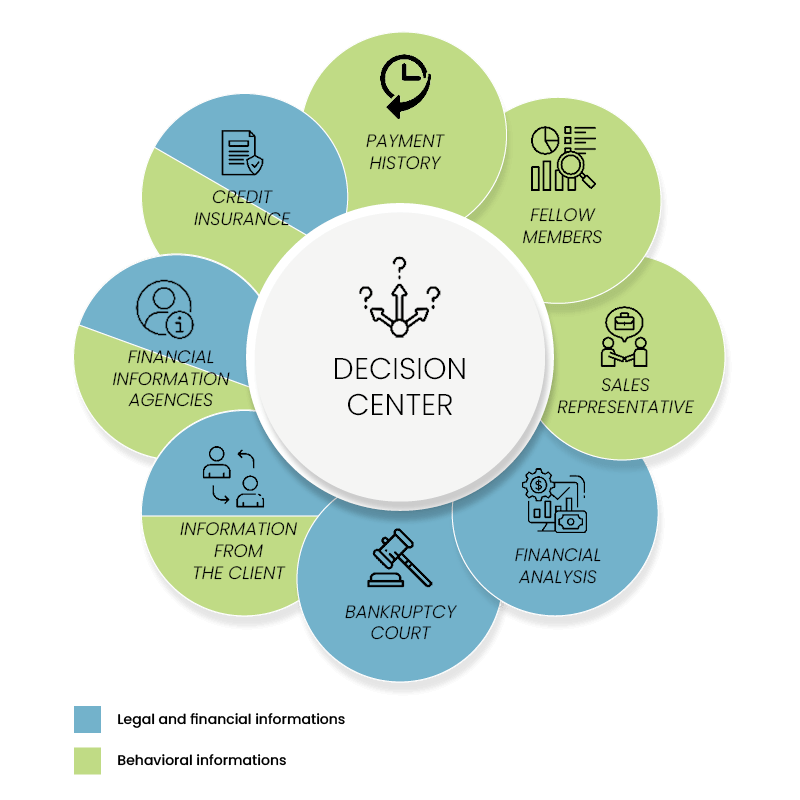
Consider the customer's industry and economic environment
Where can you obtain reliable customer credit information?
Source
What it can provide
What to check
The customer
Recent financial statements, management explanations, forecasts and operational updates.
Reporting date, consistency and supporting evidence.
Official registries
Legal identity, filings, corporate events and published financial information where available.
Coverage, filing delays and local disclosure rules.
Business information providers
Company reports, financial indicators, credit scores and monitoring alerts; examples include Dun & Bradstreet and Creditsafe.
Methodology, freshness, geographic coverage and data sources.
Credit insurers
Risk assessments, insured limits and, where provided, relevant payment or financial information.
Scope of the service and whether the insurer's risk appetite matches yours.
Your accounts receivable records
Actual payment dates, overdue balances, disputes and trends in the customer's behaviour towards your business.
Data completeness and causes of delays, including internal billing issues.
Trade references
Experiences reported by other suppliers, where lawfully and voluntarily shared.
Potential bias, comparability and permission to disclose.
Sales teams and customer visits
Current business developments, market signals and explanations for changes.
Corroboration of subjective assessments.
Specialist investigations
Deeper qualitative research in cases involving significant exposure or limited public data.
Cost, independence and reliability of findings.
Ask the customer directly
How data analytics and AI can improve credit information
Turn customer information into practical credit decisions
Continue learning
Category's rubrics
The credit analysisGet information about your clientsAnalyze the Profit and Loss accountUnderstand and analyze the balance sheetThe Tangible Net WorthCalculating key balance sheet ratiosCredit NotationHow to calculate the Z score ?Credit risk during Covid 19Credit risk, who decide
Downloadable tools are available at the bottom of the page
Key principle: credit risk management should support profitable sales while protecting cash flow. Its purpose is not to reject every higher-risk customer, but to identify risks early and manage them through proportionate commercial and payment terms.
Practical recommendation: use external scores and AI-generated indicators as decision-support tools, not as unquestionable verdicts. Your own payment history with a customer may be more directly relevant to your exposure, provided it is accurate and interpreted in context.


Comments
Comment this page
Comments are subject of editor's review before publication
Articles on the same topic