Risk management or cash collection? Which of these two activities is the most important in credit management? Should one be considered more valuable, more technical or even more “noble” than the other?
At first glance, credit risk management appears to be the more sophisticated discipline. Cash collection, on the other hand, can be mistakenly reduced to chasing overdue invoices. This distinction is misleading. Both activities require genuine expertise, and neither can deliver its full value without the other.
Credit risk management: technical expertise serving commercial decisions
Assessing and controlling customer credit risk requires a wide range of knowledge. Financial analysis, credit limits, credit insurance, bank guarantees, documentary credits and standby letters of credit all involve specific mechanisms and terminology. Their relevance varies with the customer, the industry, the country and the nature of the transaction.
Credit risk management also means interpreting information that is necessarily imperfect. Financial statements describe a past period; a customer may have deteriorated significantly since their publication. A credit manager must therefore combine financial analysis with commercial, sector-specific, contractual and behavioural information.
Typical risk management decisions
- How much credit should be granted to this customer?
- Which payment terms are appropriate?
- Is a guarantee, down payment or credit insurance needed?
- When should an exposure be reviewed or reduced?
Information needed
- Financial statements and credit information
- Customer concentration and exposure
- Country, sector and contractual risks
- Actual payment behaviour and current disputes
The objective is not to avoid all risk. Granting customer credit is part of commercial development. The challenge is to take appropriate risks, consciously and under control, while enabling the company to grow.
Cash collection: a deceptively complex profession
Cash collection may seem more accessible. Accountants, sales representatives or customer service teams sometimes perform collection activities alongside their other responsibilities. Yet achieving a high level of performance demands a combination of skills that can appear contradictory.
The collector needs accounting rigour to understand the customer account, identify discrepancies and reconcile payments. At the same time, the role requires diplomacy, commercial judgement, negotiation skills and the ability to distinguish a genuine dispute from an unjustified delay.
Collection also requires legal and contractual knowledge. A professional must know which obligations cannot be disregarded and which commercial decisions allow flexibility, subject to applicable law. In addition, handling a large volume of customers and invoices requires strong organisational skills, reliable data and appropriate digital tools.
Effective cash collection is not measured by the number of reminders sent. It is measured by the quality of the actions taken, their impact on payment, the resolution of underlying problems and the preservation of constructive customer relationships.
A good collection professional does more than obtain payment. By identifying recurring invoice errors, unresolved disputes or poorly defined payment terms, they can improve internal business processes and customer satisfaction.
Why opposing risk management and cash collection makes no sense
To answer the question, we must return to the purpose of credit management. Its ultimate objective is not simply to analyse customer risk, nor to recover invoices after they become overdue. It is to support profitable sales while ensuring that the company is paid properly and on time.
Risk analysis and collection are therefore means to a shared objective. They are complementary and continuously inform one another.
| What risk management contributes to collection | What collection contributes to risk management |
|---|---|
| Customer risk profiles help prioritise collection actions and determine appropriate escalation. | Changes in payment behaviour provide current warning signals that may not appear in financial statements. |
| Credit limits and exposure levels indicate which accounts require particular attention. | Unkept payment promises, repeated disputes or unexplained delays can trigger a reassessment of credit limits. |
| Guarantees, insurance arrangements and contractual protections influence how overdue accounts should be handled. | Direct contact with customers provides qualitative information about their operational or financial difficulties. |
| Risk segmentation helps avoid treating all customers with identical collection scenarios. | Collection results help test whether the risk assessment and credit policy are effective in practice. |
A practical example: when payment behaviour changes the risk assessment
A customer has historically paid on time and has a credit limit of €150,000. Its most recent financial statements are satisfactory. Over the past two months, however, several invoices have become overdue, payment promises have not been honoured and the outstanding balance is approaching the limit.
A collection-only approach might simply intensify reminders. A risk-only approach might continue relying on the favourable financial statements. An integrated credit management approach combines both perspectives.
- The collection team identifies the change in payment behaviour and establishes the facts.
- The credit manager reviews the current exposure, outstanding orders and reasons for delay.
- The sales team provides information about the commercial relationship and any disputes.
- Credit terms, limits, order release conditions or guarantees are adjusted if justified.
- A coordinated action plan seeks payment while preserving a viable commercial relationship.
This example illustrates why payment behaviour is valuable credit information. It does not automatically prove financial distress: delays may arise from invoice errors, administrative problems or commercial disputes. The task is to understand their cause before making a decision.
Credit management throughout the Quote-to-Cash process
Credit management operates throughout the sales cycle, not only at the point of credit approval or when an invoice becomes overdue.
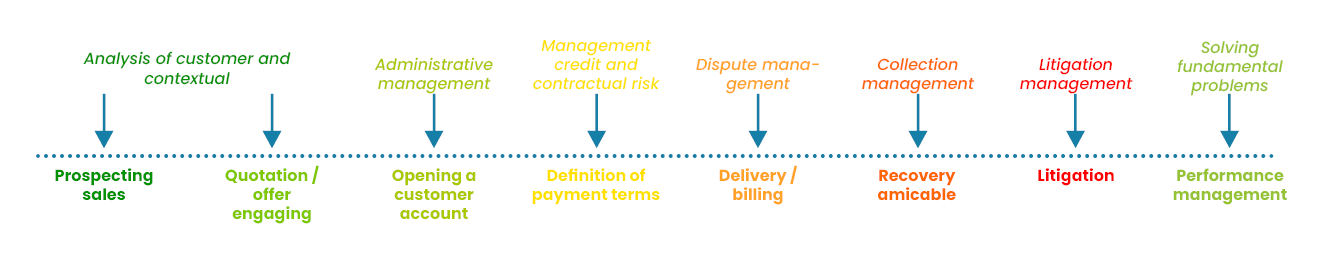
From prospecting and quotation to customer account creation, payment terms, delivery, invoicing, amicable collection, litigation and performance improvement, each stage influences the others. A contractual weakness may become a dispute. An invoicing error may create overdue receivables. An unexpected delay may reveal a new credit risk.
Understanding the customer account as a whole is therefore essential. Isolating risk management from collection can create information gaps precisely when fast, informed decisions are needed.
Digital tools and AI: reinforcing the connection
Connected credit management systems can bring together ERP and CRM data, invoices, payment status, customer risk information, disputes and collection actions. This shared view makes it easier to identify priorities and respond consistently.
Artificial intelligence can help interpret incoming messages, highlight changing payment patterns, propose relevant actions and assist teams in handling large volumes of information. But technology alone does not create performance. Its value depends on credit management expertise, reliable and interconnected data, functional software quality and the appropriate use of AI.
Automating thousands of generic reminders does not necessarily improve collection. A smaller number of well-targeted actions, informed by customer risk and the real causes of non-payment, may deliver better results.
For a broader discussion of this approach, see AI: What If We Talk About Credit Management Again?.
One profession, several complementary areas of expertise
There is no hierarchy of prestige between risk management and cash collection. Both are demanding, both influence the customer relationship and both contribute to cash flow and profitability. Their combination is one of the defining strengths of the credit management profession.
The question is not whether a company should favour risk management or collection, but how to make them work together. A credit manager who understands the entire process can act earlier, make better decisions and contribute far beyond the traditional boundaries of either discipline.