Digital DSO is the transformation of Days Sales Outstanding from a periodic financial ratio into a dynamic, detailed and actionable credit management indicator. With connected data and dedicated software, credit managers can monitor changes frequently, investigate their causes and act on the underlying business processes.
The principle is straightforward: a DSO figure is useful, but understanding why it changes, where the change occurs and what can be done about it is much more valuable. This is what digitalization makes possible.
From monthly to dynamic
Refresh DSO as source data becomes available, instead of waiting for the next monthly financial report.
From global to granular
Analyse the indicator by entity, customer, portfolio, business line, period or other relevant scope.
From reporting to action
Identify the operational reasons behind a deterioration and assign corrective actions to the right teams.
What does DSO actually measure?
Days Sales Outstanding expresses the amount of outstanding receivables in equivalent days of sales. It is not the average time customers take to pay invoices. DSO is based on receivables still outstanding at a given date, including amounts that are not yet due; an average payment delay is calculated from payment behaviour or settled transactions.
DSO reflects several elements of the order-to-cash cycle: negotiated payment terms, advance payments, invoicing practices, payment delays, disputes and the composition of receivables. Its scope must also be defined consistently: depending on the company's reporting policy, certain contract assets, unbilled receivables, credit notes or provisions may be included or excluded.
Contractual payment terms
The amount of credit deliberately granted through sales agreements and payment terms.
Advance payments
Deposits and prepayments can reduce the amount outstanding and the financing requirement.
Overdue receivables
Late payments, unresolved disputes and internal process failures add pressure to DSO.
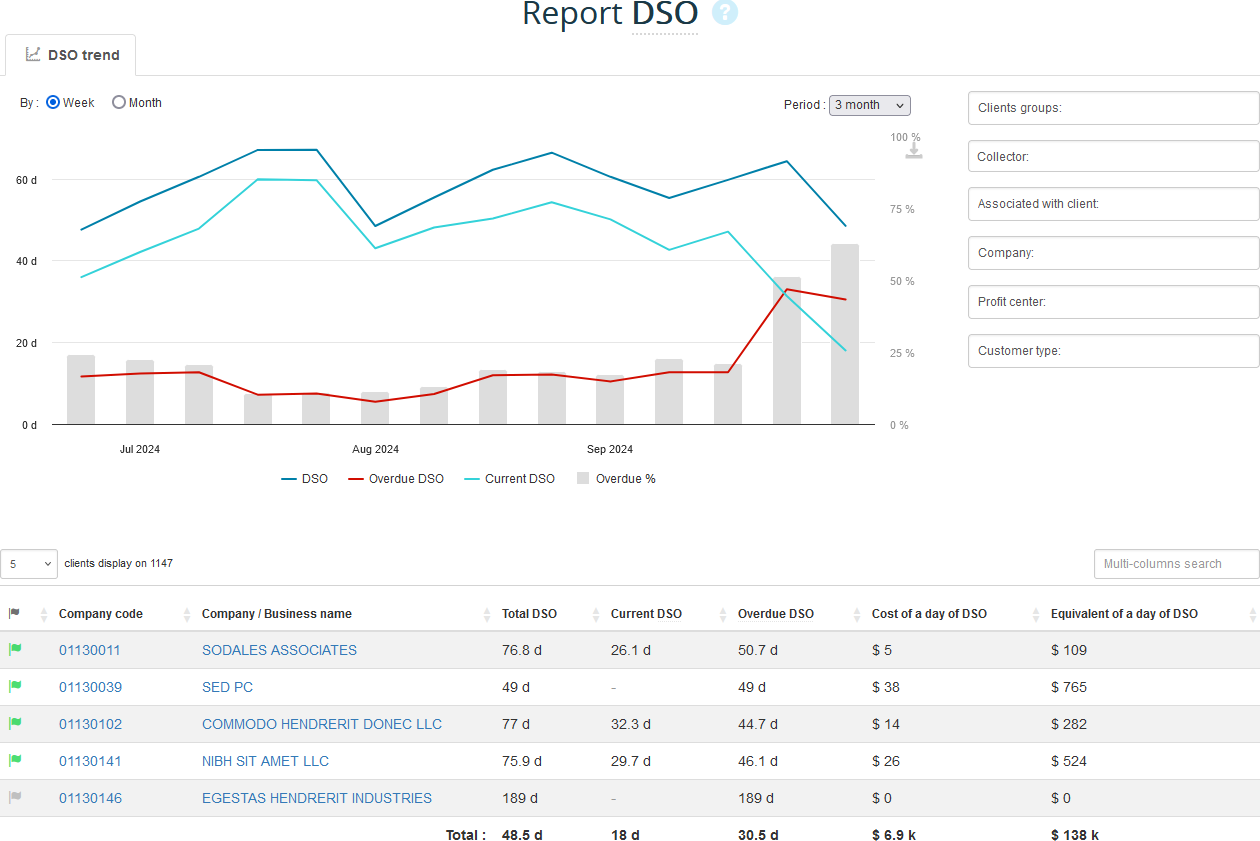
To interpret this multifactorial indicator, analyse current DSO and overdue DSO alongside the overall figure. Their exact calculation and reconciliation depend on the method and data definitions adopted by the company; they should not be confused with a universal arithmetic split into negotiated payment terms and actual delays.
For the formulas and underlying methods, see how to calculate DSO. For the broader business context, consult the principles of credit management.
How does digitalization change DSO reporting?
Traditional DSO reporting often provides one consolidated figure at the end of each month. A digital approach enables frequent recalculation and interactive analysis at different levels. The objective is not to multiply dashboards for their own sake: it is to make the information sufficiently detailed to support decisions.
| Traditional reporting | Digital DSO | Operational value |
|---|---|---|
| One global figure each month | Frequent refresh, with consistent cut-off dates | Detect deterioration earlier |
| Aggregate company-level view | Breakdown by entity, customer, business line or collector | Locate the source of a change |
| Manual reconciliation between reports | Connected receivables, invoicing and payment data | Spend less time compiling figures |
| Trend observed after the fact | Trends linked to aging, disputes and operational actions | Prioritise corrective measures |
Real-time is not automatic. The freshness and reliability of a digital DSO depend on the frequency, completeness and quality of ERP, accounting, billing and payment data feeds. Inconsistent currencies, cut-off dates, tax treatments or customer mappings can produce misleading comparisons, even in sophisticated software.
The two main DSO calculation methods
Accounting method
DSO = Outstanding receivables / Sales for the period × Days in the period
Simple and easy to communicate, but sensitive to seasonal sales patterns and changes in turnover. The numerator and denominator must be consistent, particularly regarding VAT or sales taxes.
Roll-back method
Deduct successive periods of sales from the closing receivables balance, moving backwards in time until the balance is exhausted.
This method better accommodates sales variations. Its precision depends on the granularity of the sales periods and the consistency of the data; shorter periods can reduce approximation in the final prorated period.
Neither method eliminates the need for careful interpretation. The right method depends on the organisation, business model and reporting objectives. Try the online DSO calculator using the roll-back method, or review the detailed DSO calculation tutorial.
From a change in DSO to a business decision
Imagine a company whose DSO increases from 52 to 60 days. The increase alone does not prove that the collection team is performing poorly. Digital analysis might reveal very different situations:
Scenario A: longer payment terms
A major new customer has negotiated 90-day terms, increasing current receivables while paying on time.
Action: assess the commercial decision, credit exposure, financing cost and customer profitability rather than intensifying reminders.
Scenario B: unresolved invoice disputes
Several customers are withholding payment because of incorrect purchase order references and missing delivery documents.
Action: correct the invoicing and order-to-cash processes, assign dispute owners and monitor resolution times.
The same DSO movement can therefore call for different decisions. Digital DSO becomes valuable when the causes are visible and actionable, not simply because the calculation is faster.
Which factors should credit managers monitor?
| Driver | Useful analysis | Potential response |
|---|---|---|
| Payment terms | Current DSO, customer segments, contractual conditions | Review credit policy and commercial negotiations |
| Deposits | Prepayment share, exposure before delivery | Negotiate appropriate advance payments |
| Late payments | Overdue ratio, aging and overdue DSO | Target the causes of delays and improve cash collection |
| Disputes | Volume, value, root cause and resolution time | Resolve disputes and correct recurring internal failures |
| Credit risk | Customer exposure, limits and risk profile | Adjust terms, security and risk mitigation measures |
| Payment processing | Unallocated cash, remittance information and matching delays | Improve reconciliation and data integration |
DSO should be used alongside other indicators, including the overdue ratio, bad-debt ratio, collection effectiveness, dispute resolution time and customer risk exposure. No single indicator can describe the entire performance of credit management.
What does digital DSO change for credit management teams?
It gives the credit manager the ability to move from producing a monthly report to understanding the business and influencing its processes. This is a major change in the profession: instead of spending most of the available time gathering information, teams can devote more attention to negotiations, dispute resolution, risk management and cross-functional improvement.
Tools such as My DSO Manager illustrate this approach through connected receivables data and interactive DSO analysis. But technology does not create performance on its own. Its value depends on the combination of credit management expertise, functional quality, data interconnection and relevant automation or AI.
For a broader perspective, read the era of digital credit management and how cash collection helps improve business processes.
Digital DSO: frequently asked questions
Is digital DSO a new calculation formula?
No. It refers primarily to more frequent, granular and interactive calculation and analysis. The underlying formula or roll-back methodology still needs to be defined.
Can DSO be calculated in real time?
It can be recalculated whenever updated source data is available. The actual freshness depends on the integration architecture and accounting processes.
Does a lower DSO always mean better collection?
No. DSO can fall because of shorter contractual terms, advance payments or sales-mix changes, even without any improvement in collecting overdue invoices.
Which KPI should complement DSO?
At minimum, monitor overdue receivables, aging, dispute resolution and credit losses, with consistent scopes and definitions.
Conclusion: from measurement to performance
The true potential of digital DSO lies in turning a financial indicator into a management tool. Comparing figures is useful; identifying causes, coordinating teams and improving the sales-to-cash process is what creates value.
The goal is not to calculate DSO more often. It is to make better decisions, sooner.