Collection level 2 is the stage at which an unpaid invoice can no longer be treated as a simple oversight. After preventive collection and the first reminders, the supplier must establish precisely why payment has not been made, resolve any genuine obstacle and obtain a firm commitment from the customer.
The objective is not to send more reminders for the sake of sending them. It is to increase the effectiveness and firmness of the collection process, while keeping it professional and preserving the possibility of an amicable resolution.
When does collection level 2 begin?
Collection level 2 is the third stage of a typical collection scenario, following preventive collection before the due date and collection level 1. It generally concerns invoices that remain unpaid after several attempts to obtain payment.
Depending on the company's activity, customers and commercial strategy, this stage may take place approximately 8 to 30 days after the due date. These figures are practical guidelines, not a mandatory timetable. A well-designed collection scenario adapts the sequence and intensity of actions to the situation.
At this point, familiar explanations such as a lost cheque or an absent accountant should no longer be accepted without verification and a credible resolution date. The collector needs facts, responsibilities and commitments.
Identify the real reason for non-payment
There are two broad possibilities: the invoice is unpaid because of a genuine problem, or the customer has no valid reason for continuing to delay payment.
A genuine dispute or administrative obstacle
A customer may be waiting for a credit note, a corrected invoice, a delivery confirmation or the resolution of a commercial dispute. The collector's role is then to coordinate the people who can resolve the problem: sales, logistics, technicians, customer service and the customer's purchasing or accounts payable teams.
Invoices that are accepted and payable should not be unnecessarily held up by a separate disputed item. Where appropriate, ask the customer to pay the undisputed balance while the issue is being resolved.
Once the dispute has been resolved, inform the customer clearly of the outcome, confirm the amount due and obtain a payment date. The collector remains responsible for following the case through to settlement, even when another department carries out the corrective action.
Communicate to get action. Effective dispute management requires precise follow-up and relevant information delivered to the right person at the right time. Read more about invoice dispute management.
No justified reason for non-payment
When the debt is certain, quantified and due, and no legitimate obstacle remains, continued non-payment generally points to a willingness to delay settlement or an inability to pay. The two situations call for different responses.
A customer deliberately postponing payment needs a consistent, increasingly firm follow-up. A customer experiencing genuine financial difficulty needs a realistic assessment of its capacity to pay and of the supplier's exposure. In both cases, repeating the same unanswered email is unlikely to achieve much.
Collection level 2: a more assertive sequence of actions
The original example below shows a simple, progressive scenario: a call from the sales representative at approximately 10 days overdue, followed by a further reminder email at approximately 14 days overdue. If the situation remains unresolved, the account moves to the next level.
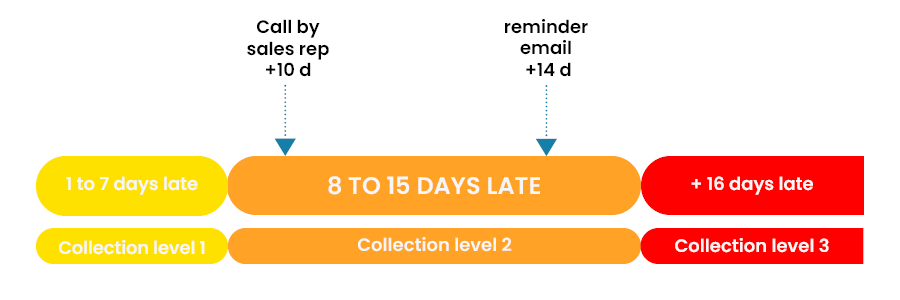
The actions can include:
| Action | Purpose | Good practice |
|---|---|---|
| Direct telephone contact | Obtain a clear explanation and a firm payment commitment | Prepare the call using the customer's history, outstanding invoices and previous promises |
| Sales representative intervention | Reach a different decision-maker and reinforce the importance of payment | Coordinate the message with the collector; avoid contradictory commitments |
| More formal written reminder | Confirm the amount due, urgency and expected action | Use email or an appropriate traceable delivery method and retain evidence |
| Late-payment charges | Apply the contractual and legal consequences of delay | Check the applicable terms and law; see late-payment penalties |
| Credit review or account hold | Limit further exposure and encourage regularisation | Coordinate with sales and credit management, taking contractual obligations into account |
| Escalation | Ensure that the amicable process progresses towards a decision | Set a clear deadline and move to level 3 if the situation does not improve |
Use different communication channels when this helps reach the right person: telephone, email, interactive email and formal correspondence. A registered electronic delivery service can be useful where proof of dispatch and receipt matters. The objective is a reliable exchange, not a multiplication of messages.
Every action should be recorded. The history of calls, explanations, promises and disputes enables the collector to prepare the next discussion and prevents the customer from offering the same unverified explanation repeatedly.
Involve the sales representative
The sales representative's intervention is often particularly effective at collection level 2. The collector generally communicates with accounts payable, while the sales representative may have direct access to the purchasing manager, operational manager or company director.
These different relationships can help identify the true reason for non-payment and unblock a decision quickly. The sales representative should not replace the collector: both must act in a coordinated manner, with a shared understanding of the situation and the same expectation of payment.
Involving the commercial team is also a clear message that respecting payment terms is part of the business relationship. A supplier can value its customer and still expect its invoices to be paid when due.
Consider blocking new orders or deliveries
When repeated reminders have failed, an account hold can be an effective collection measure. A message such as "We will be able to release your next order once the overdue balance has been settled" may be enough to obtain payment from a customer who is capable of paying but has been postponing it.
It also has a protective function: if the customer cannot pay, continuing to supply goods or services on credit may increase the potential loss.
This measure should be decided with the appropriate commercial and credit management stakeholders and applied consistently with the contract and applicable law. It is a risk-management decision, not a substitute for understanding the customer's situation.
Bring the customer to a clear decision
Collection level 2 should progressively remove uncertainty. At the end of this phase, the collector should know whether the invoice will be paid, whether a specific issue remains to be resolved, or whether the customer is facing a financial problem.
Where financial difficulties are genuine, a negotiated payment plan may be appropriate, depending on the customer's situation, the relationship and the supplier's risk appetite. Any arrangement should be realistic, documented and monitored closely.
Otherwise, the customer must understand that the collection process will continue, with increasing firmness, until the debt is resolved. The amicable collection process must not become an endless succession of reminders.
This intermediate stage is therefore decisive. The collector's expertise lies in accurately identifying the nature of the unpaid debt, mobilising the right people and adapting the response. Most ordinary payment delays should be resolved before the situation reaches the final amicable stage.
Continue to collection level 3 →
Using credit management software
My DSO Manager helps teams schedule appropriate reminders, maintain a complete history of interactions, coordinate dispute resolution and adapt collection actions to each account. The trigger for an action can reflect the collection scenario, account situation, history and other relevant criteria.
Digital tools can make reminders more timely and consistent, but the quality of collection still depends on the relevance of the action and the expertise of the person responsible for the account.

