Getting invoices paid on time is not simply a matter of sending reminders. Effective B2B cash collection brings together prevention, customer dialogue, dispute resolution and disciplined follow-up. It protects cash flow while strengthening the quality of the commercial relationship.
Collection is one of the most visible activities of Credit Management, but its impact goes far beyond overdue receivables. A well-organised collection process also reveals weaknesses in invoicing, sales administration, delivery and customer service. Resolving these issues helps prevent future late payments.
What is the purpose of B2B cash collection?
The first objective is straightforward: ensure that invoices are paid on their contractual due dates. However, collecting receivables effectively also means identifying why payment might be delayed and removing the obstacles before they become overdue debts.
A sound approach contributes to several objectives at the same time:
- Cash flow: reduce overdue receivables and the working capital tied up in customer accounts.
- Risk management: identify deteriorating payment behaviour and potential financial difficulties early.
- Customer satisfaction: solve administrative and commercial problems rather than repeatedly demanding payment.
- Operational quality: identify recurring failures in the order-to-cash process and correct their causes.
- Commercial credibility: demonstrate that payment terms and commitments are taken seriously.
Cash collection is primarily an amicable, professional activity. The objective is not to create conflict but to coordinate the right people and actions so that an agreed commercial transaction ends with payment.
Digitalisation makes collection more collaborative
Electronic invoicing, customer portals, online payments, integrated ERP data and interactive communications have changed the way suppliers and customers exchange information. Properly used, these technologies reduce repetitive administrative work and allow collection teams to concentrate on negotiation, complex disputes and situations requiring professional judgement.
The decisive factor is not the number of automated messages sent. It is the relevance of each action, the reliability of the information available and the ability to resolve the underlying issue.
An interactive customer portal
An interactive portal can provide customers with the information and services needed to validate and pay their invoices:
- A clear statement of account showing open and overdue items.
- Invoice copies and supporting documents.
- Invoice statuses, comments and information about outstanding disputes.
- Contact details and appropriate payment instructions.
- The ability to communicate directly with the collection team and share payment commitments.
- Online payment options where available and appropriate.
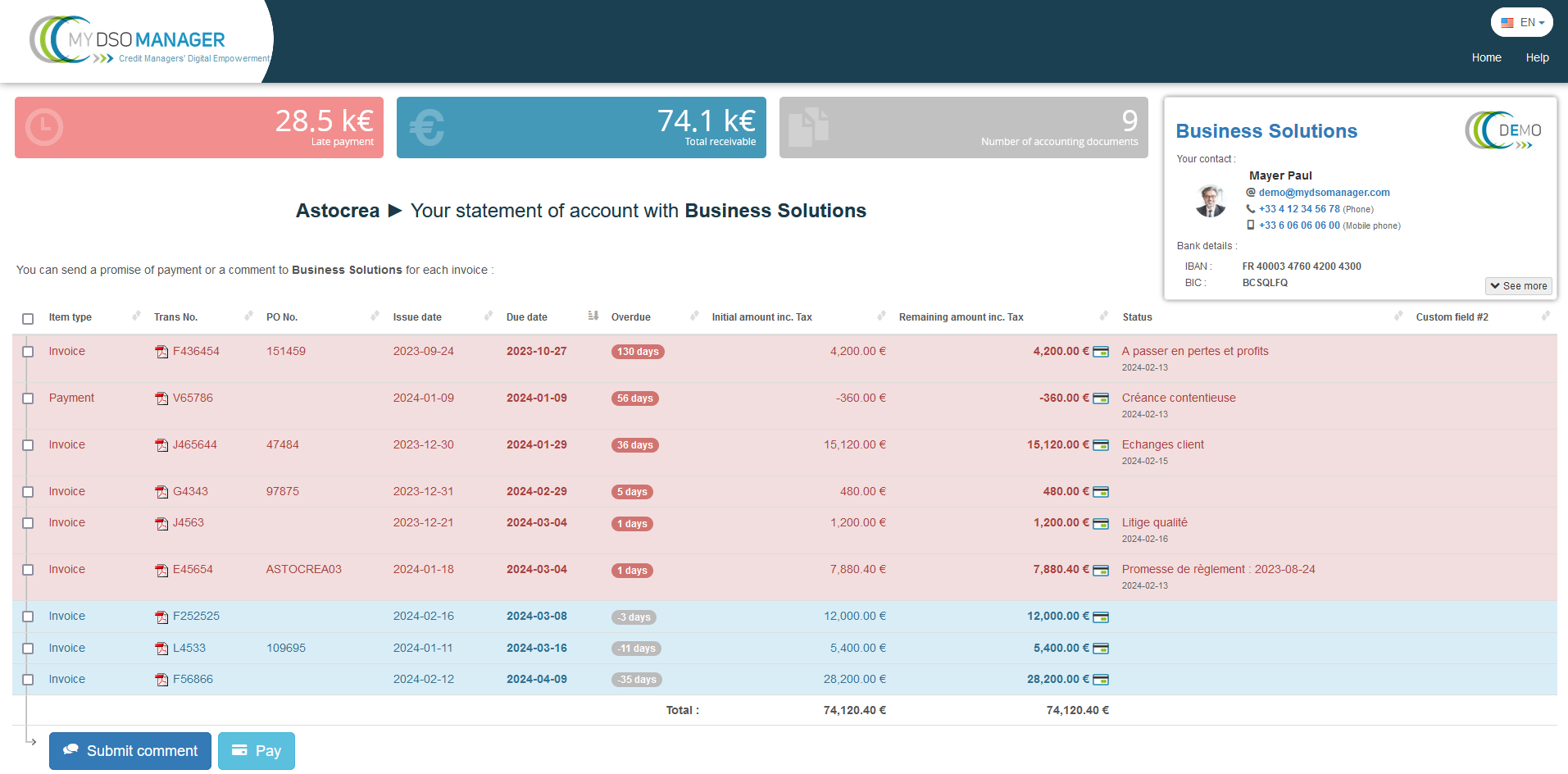
Such tools are particularly useful when they are connected to accurate, up-to-date accounting and commercial data. A portal does not resolve a dispute by itself: the company must still assign responsibility and act on the information received.
How to organise an effective collection process
Collection should follow a structured collection scenario, with actions that become progressively more direct as the delay increases. The scenario provides consistency without preventing the collector from adapting to the customer's situation.
The process starts before the due date, particularly for significant invoices, new customers or accounts with a history of delays. Early contact can identify missing purchase orders, invoice errors, delivery disputes or validation procedures before payment is due.
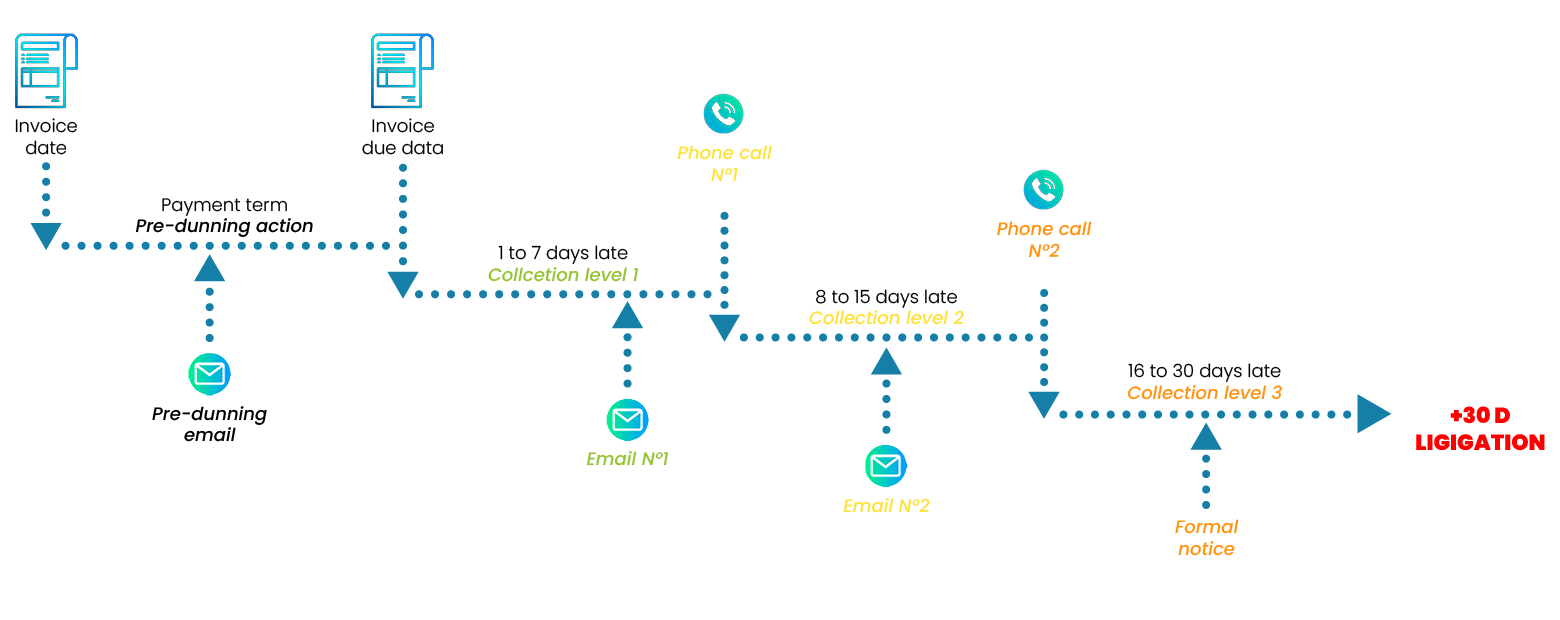
| Stage | Main objective | Typical action |
|---|---|---|
| Before due date | Remove obstacles and confirm the payment process | Preventive email, account statement or targeted contact |
| Collection level 1 | Understand the delay and obtain a reliable payment date | Personalised reminder and direct exchange |
| Collection level 2 | Escalate unresolved cases and obtain a firm commitment | Telephone discussion, written confirmation and internal escalation |
| Collection level 3 | Bring the amicable phase to a clear conclusion | Formal demand or final escalation, as appropriate |
| Further action | Protect the company's rights when amicable collection fails | Review of guarantees, external recovery or legal proceedings |
These stages are not an automatic countdown. A genuine dispute requires resolution, a customer facing temporary cash difficulties may require negotiation, and a high-risk exposure may justify faster escalation. What matters is that every outstanding balance has a clear next action and an accountable owner.
The amicable phase must also have an end. Repeatedly accepting unfulfilled promises without changing strategy is not effective collection.
The principles of successful cash collection
Contact the right person
Payment may depend on several people: the buyer, accounts payable team, operational manager, invoice approver or treasury department. Identifying the person who can actually remove the obstacle is often more useful than sending another reminder to a generic address.
Remain professional, but become firmer when necessary
Clear, courteous and factual communications reinforce credibility. The tone should reflect the history of the relationship, the reason for non-payment and the seriousness of the delay. Firmness does not require aggression.
Record commitments and actions
Document contact dates, customer explanations, payment promises, dispute details and agreed next steps. Confirm important commitments in writing. A reliable history improves continuity, supports escalation and may be useful if formal recovery becomes necessary.
Resolve disputes rather than repeatedly chasing the same invoice
Not every unpaid invoice results from unwillingness or inability to pay. Missing documents, pricing errors, delivery issues and quality problems are common obstacles. A collection team should be able to identify them and coordinate their resolution with the relevant department.
See our tutorial on how to manage customer disputes effectively.
Avoid indiscriminate mass reminders
Sending the same message to every customer regardless of context can damage the commercial relationship and waste time. Automation is valuable when it applies an appropriate strategy to reliable information; it becomes counterproductive when it merely multiplies irrelevant contacts.
Seven payer profiles and how to approach them
Collection becomes more effective when actions reflect the customer's actual behaviour. The following seven profiles are practical categories, not permanent labels: the same customer may behave differently depending on the invoice, the circumstances and the relationship.
| Payer profile | Typical behaviour | Recommended approach |
|---|---|---|
| Negligent payer | Payment is delayed by oversight or low priority. | Use a timely, friendly reminder and make payment easy. |
| Deliberately late payer | Payment is postponed to preserve cash or obtain extra credit. | Follow up consistently, set firm deadlines and escalate when commitments are missed. |
| Financially distressed payer | The customer cannot meet obligations when due. | Assess exposure, coordinate with credit risk management and negotiate realistic, documented arrangements where appropriate. |
| Administrative payer | Complex approval processes delay payment. | Map the validation workflow, identify decision-makers and supply the required documents early. |
| Disputing payer | Invoices are challenged, sometimes repeatedly. | Distinguish valid disputes from delaying tactics; resolve genuine issues promptly and document the outcome. |
| Automatic payer | Payments are processed through an established automated method. | Monitor exceptions, mandates and failed payments rather than sending unnecessary reminders. |
| Reliable payer | Invoices are normally settled on time. | Maintain a smooth relationship and intervene only when a meaningful exception occurs. |
Understanding why a customer does not pay is more useful than assuming that every late payer needs the same reminder. This is where the collector's experience and judgement make the difference.
Use collection to improve the whole order-to-cash process
Collection performance cannot be assessed solely by counting calls, emails or letters. The quality of the outcome matters more than the volume of activity.
- Overdue receivables and ageing: how much remains unpaid, and for how long?
- Payment commitments: what proportion of promises are honoured?
- Disputes: how quickly are they resolved, and which causes recur?
- Collection effectiveness: are actions generating payments and sustainable improvements?
- Customer experience: are unnecessary reminders and avoidable payment obstacles decreasing?
These findings should be shared with sales, administration, operations and finance. Collection then becomes a means of improving the company's internal processes, not merely a reaction to late payments. Read more about improving business processes through cash collection and the key principles of effective collection.
Digital tools support the collector's expertise
Dedicated credit management software can centralise receivables, customer communications, dispute statuses, payment commitments and action histories. It can also apply differentiated collection scenarios and help teams prioritise their work.
My DSO Manager, for example, combines collection workflows, interactive communications and collaborative dispute management. Its purpose is to help teams spend less time on repetitive tasks and more time on situations where their expertise makes a difference.

For a broader overview, see how to choose credit management software.
Conclusion
Good collection is not about chasing customers harder. It is about understanding what prevents payment and acting effectively to remove that obstacle. A structured process, professional communication, reliable information and strong collaboration allow companies to collect on time while preserving customer relationships.
Ultimately, cash collection is both a financial discipline and a powerful indicator of the quality of the company's entire order-to-cash process.