Electronic invoicing is much more than a new way of sending invoices. When invoice statuses, customer information and payment data circulate between connected systems, it can fundamentally change how companies manage accounts receivable and cash collection. For credit managers, the opportunity is not to send more reminders. It is to understand earlier why an invoice is not progressing, resolve obstacles faster and focus collection efforts where they create value.
1. What changes with electronic invoicing?
Traditional invoicing often relies on documents sent by email, followed by manual entry, separate approval workflows and limited feedback to the supplier. Structured electronic invoicing introduces machine-readable invoice data and, depending on the applicable system, exchanges through approved or accredited platforms.
In France, the reform concerns domestic transactions within its scope and includes both e-invoicing and e-reporting obligations. A conventional PDF attached to an email does not, on its own, meet the new e-invoicing transmission requirements. Accepted formats include structured formats such as UBL and CII, and hybrid formats such as Factur-X, when transmitted through the prescribed framework.
Structured information
Invoice data can be read and checked by software without re-entering every field manually.
More visibility
Available lifecycle statuses can help identify rejection, processing or payment-related events earlier.
Connected workflows
ERP, invoicing platforms and credit management software can exchange information and trigger appropriate actions.
2. The French reform: implementation timetable
| Date | Main obligation |
|---|---|
| 1 September 2026 | All businesses within scope must be able to receive electronic invoices. Large companies and intermediate-sized enterprises must issue electronic invoices and comply with applicable e-reporting obligations. |
| 1 September 2027 | Small and medium-sized enterprises and micro-enterprises must also issue electronic invoices and comply with applicable e-reporting obligations. |
Companies should verify their classification, transaction scope, selected approved platform and current regulatory requirements. These dates concern France; they must not be applied automatically to customers or subsidiaries in other countries.
3. Understand the new invoice lifecycle
An invoice is no longer merely a document with an issue date and a due date. It can generate structured events as it moves through issuance, transmission, receipt and processing. Some events indicate a technical problem; others relate to the buyer's business process or payment.
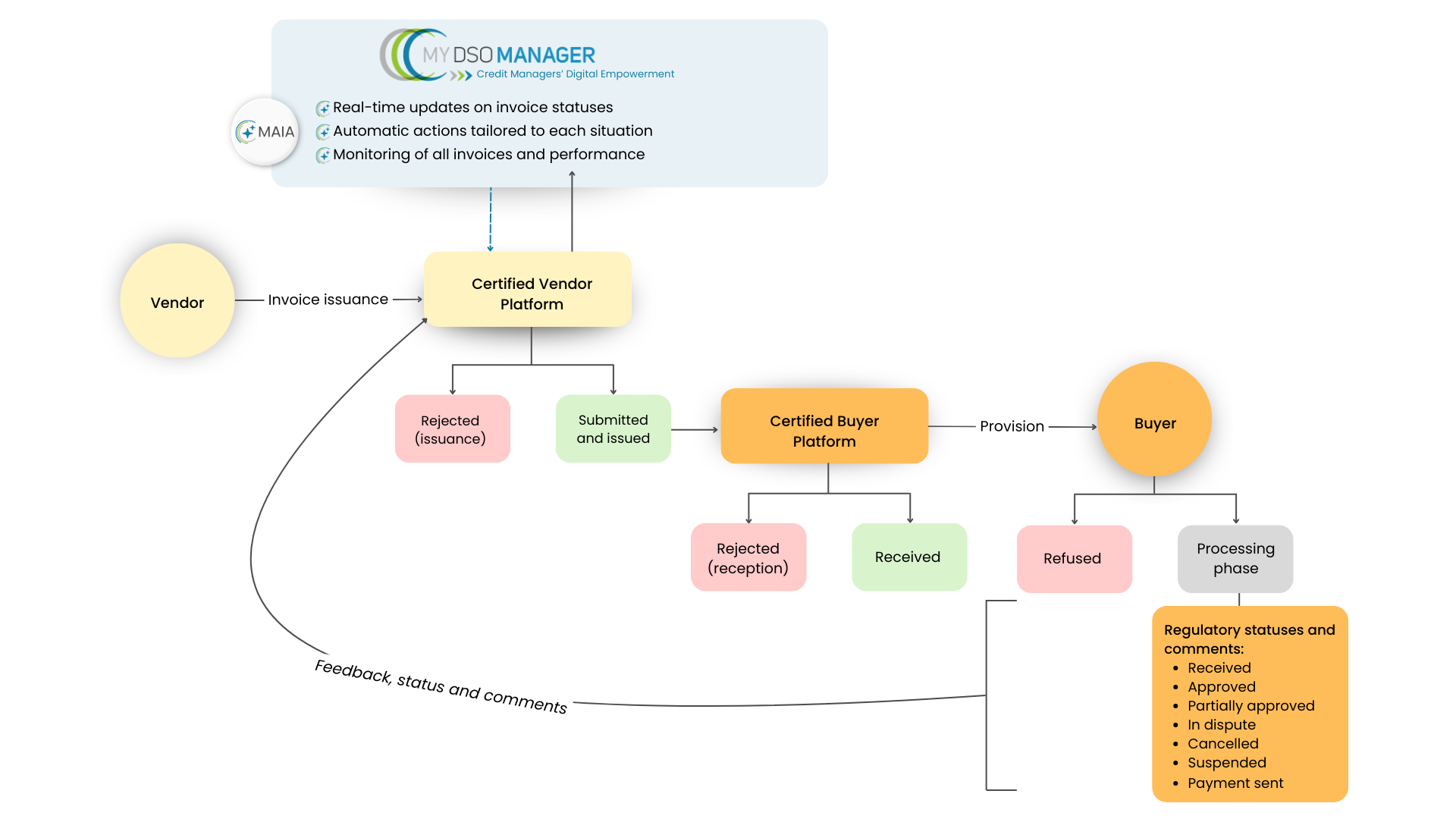 buyer and My DSO Manager, with invoice statuses and feedback" loading="lazy" />
Important: status availability, timing and meaning depend on the platform, jurisdiction and buyer workflow. A status showing that an invoice has been received does not necessarily mean that it has been commercially approved. Nor does approval guarantee that payment has been executed.
4. Match the collection action to the invoice status
A reminder sent solely because an invoice has reached its due date can be ineffective if the invoice was rejected days earlier or is still blocked in an approval process. The credit manager needs both the contractual payment obligation and the operational status.
| Situation | Priority action | What to avoid |
|---|---|---|
| Invoice rejected for a technical or data error | Identify the rejection reason, correct the invoice and ensure successful resubmission. | Sending an ordinary overdue-payment reminder. |
| Invoice received but pending buyer processing | Identify the approval owner and verify missing purchase orders, delivery evidence or other requirements. | Assuming receipt means approval. |
| Invoice disputed | Qualify the dispute, assign an owner, agree on a resolution deadline and secure payment of undisputed amounts where appropriate. | Suppressing all follow-up indefinitely. |
| Invoice approved and overdue | Request a precise payment commitment and escalate according to risk, amount and customer history. | Repeated generic reminders without a next action. |
| Payment announced or initiated | Verify the payment reference, expected settlement date and bank reconciliation. | Treating a payment status as proof that cash has reached the bank. |
5. Integrate platform data into credit management
Electronic invoicing only transforms cash collection if the available information reaches the people and systems that can act on it. An isolated invoicing platform may improve compliance while leaving the collection team dependent on emails, spreadsheets and manual searches.
Connect the systems
Synchronize ERP receivables, platform statuses, customer records, disputes, commitments and payment information wherever interfaces and permissions allow.
Keep a single operational view
Give credit managers the information needed to understand each account without switching between disconnected applications.
Assign responsibility
Route administrative rejections to billing teams, commercial disputes to the relevant business owners and overdue approved invoices to collection specialists.
Use automation selectively
Trigger alerts and appropriate follow-up based on reliable events, without confusing technical statuses with legal or commercial decisions.
This is where specialized credit management software adds value. My DSO Manager, for example, is designed to connect receivables information with collection actions, so teams can combine invoice-level visibility, customer context and follow-up workflows. The effectiveness of any such integration depends on the actual interfaces, data quality and coverage of the invoicing platforms concerned.
6. Prevent disputes instead of merely collecting overdue invoices
Structured invoicing can detect certain missing or inconsistent fields earlier. It cannot, by itself, prevent a disagreement about pricing, delivery, service quality or contractual performance. Those issues still require business expertise and cooperation between departments.
Credit management teams should analyze recurring rejection reasons and disputes. If the same purchase-order problem affects dozens of invoices, the best solution is not a more sophisticated reminder scenario: it is to correct the upstream order-to-cash process.
7. Rethink prioritization, automation and AI
Traditional collection scenarios often prioritize by days overdue. Electronic invoicing makes it possible to add operational signals: rejection age, processing stage, dispute reason, promised payment, customer behavior and the amount at risk.
AI may help classify incoming information, identify patterns, suggest priorities and prepare responses. But it cannot compensate for unreliable data, poorly designed workflows or missing expertise. The objective is not to automate more; it is to make better decisions and eliminate unnecessary actions.
How to measure the benefit
- Time between invoice rejection and correction
- Share of invoices rejected or blocked for administrative reasons
- Average time required to resolve a dispute
- Number of reminders sent on invoices that are not yet actionable
- On-time payment rate, overdue balances and DSO
- Time spent searching for information across systems
These indicators help distinguish an actual improvement in cash collection from a technology deployment that merely creates additional dashboards.
8. A practical implementation checklist
Before go-live
- Map invoice types, entities and legal obligations.
- Choose and test the relevant platforms.
- Verify customer master data and identifiers.
- Define rejection, dispute and payment-status ownership.
After go-live
- Monitor status completeness and data latency.
- Connect statuses to the collection workflow.
- Adapt reminder scenarios and escalation rules.
- Review operational indicators and recurring causes of delay.
Key takeaways
Electronic invoicing can accelerate processing, reduce certain administrative errors and provide better visibility over invoice workflows. However, it does not automatically eliminate disputes or reduce DSO. Results depend on data quality, system integration and the ability of teams to act on the information received.
The major change for credit management is the shift from a process based mainly on invoice age to one that combines dates, statuses, customer context and business expertise. As information systems become more interconnected, mass reminders become less relevant and targeted resolution becomes more important.
Frequently asked questions
Further reading
- Artificial intelligence in cash collection
- Improve business processes through cash collection
- How to choose credit management software