A customer who pays an invoice after its due date does more than postpone a transfer: the supplier must spend time and resources obtaining payment. Fixed compensation for recovery costs is intended to recognise those costs and discourage late payment. In France, the amount is €40 per overdue invoice in qualifying business-to-business transactions.
It may not be enough to frighten a determined late payer. But multiply it by the number of overdue invoices, add late payment interest, and the amount can become significant. More importantly, requesting it clearly reinforces the supplier's credibility and its commitment to contractual payment terms.
What is fixed compensation for recovery costs?
Late payment creates administrative and financial costs: identifying overdue invoices, contacting customers, resolving problems, monitoring commitments and sometimes involving external recovery professionals. Late payment interest compensates for the financing delay; a fixed recovery charge helps compensate for the work required to obtain payment.
Under the framework established by EU Directive 2011/7/EU, qualifying commercial transactions entitle the creditor to a minimum fixed compensation of €40 when late payment interest becomes payable. The entitlement arises without the need for a reminder, and reasonable additional recovery costs may also be claimed when they exceed the fixed amount.
It is a separate entitlement from late payment interest and penalties. The two can be claimed together when the applicable rules allow it.
International comparison: not every country uses the same amount
For an international supplier, the first question is not simply how much to charge. It is which law governs the transaction and whether the relevant legislation applies to that customer and invoice.
| Market | Fixed recovery-cost compensation | Practical point |
|---|---|---|
| France | €40 per qualifying overdue B2B invoice | Statutory entitlement, without a reminder; mandatory information on invoices and in applicable general terms of sale. |
| European Union | At least €40 under the EU late-payment framework | Member States implement the directive through national law; amounts, procedures and additional remedies may differ. |
| United Kingdom | £40 for debts under £1,000; £70 for debts from £1,000 to £9,999.99; £100 for debts of £10,000 or more | Statutory fixed compensation may be claimed on qualifying late commercial payments, alongside applicable interest. |
| United States | No equivalent universal federal €40 or fixed B2B recovery charge | Look to state law, contractual collection-cost provisions and the nature of the debt. |
| Other countries | Varies by jurisdiction | Check applicable national rules and contract terms before requesting any statutory or contractual fee. |
For cross-border transactions, a supplier should not automatically apply the French €40 rule simply because it is established in France. The governing law, the type of customer and the relevant national implementation must be assessed.
The French €40 fixed recovery compensation
France introduced this mechanism following the law of 22 March 2012, with the obligation taking effect on 1 January 2013. The relevant provisions are now found principally in Article L.441-10 of the French Commercial Code, with the amount set by Article D.441-5.
In qualifying business-to-business transactions, €40 is due for each invoice paid after its due date. No prior formal notice or reminder is required. The amount does not vary according to the invoice value or the number of days overdue.
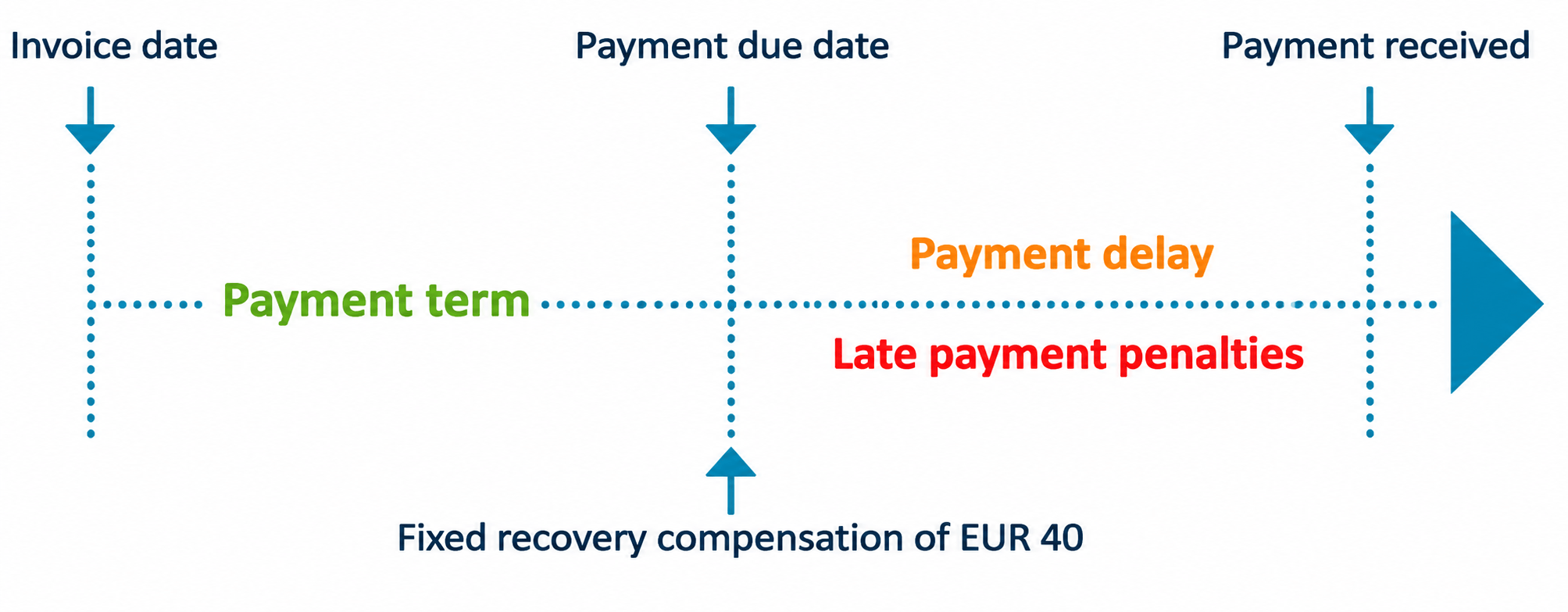
For clarity, the timeline is: invoice issue → contractual payment period → due date → first day overdue (€40 fixed compensation and late payment interest) → payment.
Scope and main conditions
- The rule concerns qualifying transactions between professionals; it does not apply in the same way to consumer invoices.
- The fixed amount is due per overdue invoice, not once per customer account or once per collection campaign.
- It is not subject to VAT as consideration for a supply, and the right to it does not depend on issuing a new invoice for the compensation.
- It is not included in the principal amount used to calculate late payment interest on the original invoice.
- Where justified recovery costs exceed the fixed amount, additional compensation may be claimable under the applicable rules.
- Specific restrictions apply in insolvency proceedings; an entitlement should not be treated as overriding rules that prohibit payment of pre-existing debts.
A concrete example: one customer, several overdue invoices
Consider a customer with 12 overdue invoices. The fixed recovery compensation amounts to 12 × €40 = €480, before any late payment interest. For a customer who systematically pays invoices late, the total can become a meaningful financial incentive to improve payment behaviour.
It is precisely this combination that makes the system useful: a modest charge on a single invoice, but a much more dissuasive amount when late payments are repeated.
How to apply the compensation in practice
1. Include it in your general terms and conditions of sale
French commercial rules require the fixed compensation amount to be included in the applicable payment terms. This is not just a formality. It demonstrates that the supplier knows the rules and intends to enforce agreed payment deadlines.
Example wording for French-law B2B terms (English translation):
Any payment received after the due date shall give rise, without prior notice, to late payment interest at the rate stated in these terms and conditions and to fixed compensation for recovery costs of €40 per overdue invoice, in accordance with Articles L.441-10 and D.441-5 of the French Commercial Code.
If a contractual annual interest rate of 12% is used, its compliance with the statutory minimum must be checked for the relevant period. Do not assume a fixed rate remains compliant indefinitely.
2. Mention it on your invoices
French rules also require invoices to mention the fixed recovery compensation applicable in the event of late payment. An appropriate English-language indication is:
Fixed compensation for recovery costs in the event of late payment: €40 per overdue invoice.
Failure to include mandatory payment information can expose a supplier to administrative penalties. The rules and sanctions have evolved since the original 2012 legislation, so older article numbers and historical fine amounts should not be reused without checking the current texts.
3. Include it in collection communications
The €40 compensation can be requested together with the principal and late payment interest, where applicable. The claim should be transparent and easy to understand: identify the invoices concerned, the due dates and the calculation.
| Component | Illustrative amount |
|---|---|
| Principal overdue on three invoices | €9,000 |
| Fixed recovery compensation (3 × €40) | €120 |
| Late payment interest | Calculated separately according to the applicable rate and delay |
There is no need to send a threatening message. A factual statement of the amounts due and a clear request for payment is often more effective.
4. Use your credit management system
In My DSO Manager, the fixed compensation can be enabled at customer level and automatically added to collection communications. It can be combined with late payment interest in the amounts claimed, while allowing the company to choose the customers for whom these amounts are requested.
This is useful for implementing a consistent policy across a portfolio without asking collectors to calculate every charge manually.
A useful credit management tool, not just a legal detail
We strongly encourage companies to incorporate fixed recovery compensation into their commercial documents and to consider claiming it when invoices are paid late.
Its benefits are both financial and behavioural:
- It removes the feeling of guilt. The supplier is applying an existing legal right, rather than inventing an arbitrary punishment.
- It deters repeated delays. Combined with interest, the amount becomes significant when numerous invoices are overdue.
- It reinforces professionalism. A company that clearly states and consistently follows its terms is more credible.
- It supports negotiation. Where commercially appropriate, the supplier may use the claim as part of a structured discussion about payment behaviour and future commitments.
Late payment is an anomaly in business relationships, yet suppliers often hesitate to assert their rights for fear of upsetting the customer. This reluctance is frequently misplaced. The customer who pays late without justification is the party failing to respect the agreement.
Claiming compensation does not require aggression. The right approach is to combine firmness on payment commitments with professionalism and an understanding of the customer's circumstances.
And, as with all collection activity, your actions educate your customers. If overdue invoices never have consequences, customers have little reason to treat your due dates as a priority.
Frequently asked questions
Does the creditor have to send a reminder first?
No, not under the French statutory mechanism for qualifying B2B invoices. The fixed compensation becomes due when the payment deadline is missed.
Is the amount €40 per reminder or per invoice?
Per qualifying overdue invoice. Sending three reminders for one invoice does not create three separate €40 charges.
Can the charge be claimed after the customer has paid the principal?
The entitlement may arise from the late payment even if the principal is subsequently settled. Whether and how to pursue the remaining claim depends on the applicable rules, limitation periods and the company's commercial policy.
Is it subject to VAT?
In France, the statutory fixed compensation is not consideration for a taxable supply and is not subject to VAT. The treatment of recovery charges elsewhere should be checked locally.
Can the supplier claim additional recovery costs?
Yes, where the applicable law permits and the additional reasonable costs can be justified. Under the EU framework, the creditor may seek reasonable compensation for recovery costs exceeding the fixed sum.
How should it be recorded in the accounts?
Accounting depends on whether the company is the creditor or debtor and on the relevant accounting standards. In France, the original Etrepaye.fr tutorial mentions account 6681 (interest on trade debts) for the debtor-side treatment. The appropriate entry for a creditor receiving the compensation is different; confirm the account classification with the company's accounting policy.
What if the customer is abroad?
Do not automatically add the French €40 charge to every export invoice. Determine the applicable law and the statutory or contractual entitlement for the transaction. Within the EU, the directive provides a common minimum framework, but national implementations can differ.
Conclusion: use the rights available to you
Fixed compensation for recovery costs is another tool available to suppliers seeking to protect their payment terms. It complements late payment interest and a structured collection process.
The most common obstacle is not the absence of legal rights but the reluctance to use them. Suppliers should not be afraid to defend contractual payment deadlines. A firm, transparent and professional policy benefits cash flow, reinforces credibility and contributes to healthier commercial relationships.
For the complementary financial mechanism, read Late Payment Penalties: Rates, Calculation and B2B Rules.