Delegation of Payment: How to Secure B2B Receivables
When a customer has limited creditworthiness but sells to a financially stronger end customer, a delegation of payment may help the supplier secure payment without abandoning the transaction. This mechanism is particularly relevant in France and requires a carefully drafted agreement.
What Is a Delegation of Payment?
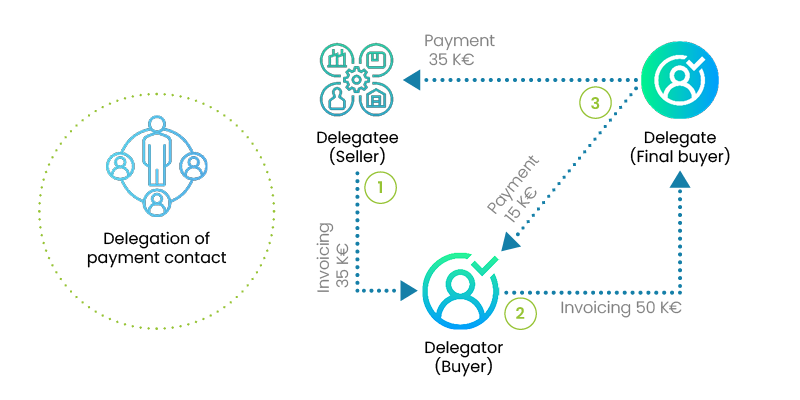
A delegation of payment is a three-party arrangement in which a third party agrees to undertake a payment obligation towards a creditor. In a typical supply chain, the supplier is paid by its customer's own customer, subject to the terms of the agreement.
- Delegator: the supplier's customer, who arranges the delegation.
- Delegate: the end customer, who undertakes to pay the supplier.
- Delegatee: the supplier, who receives the delegate's undertaking.
For example, a subcontractor supplying materials to a contractor may negotiate an undertaking from the project owner to pay the subcontractor directly. The precise rights depend on the contract and the applicable law.
Two Forms of Delegation Under French Law
French law distinguishes between délégation imparfaite (non-novatory delegation) and délégation parfaite (novatory delegation). The distinction matters because it determines whether the original debtor is released.
| Point | Non-novatory delegation | Novatory delegation |
|---|---|---|
| Original debtor | Generally remains liable alongside the delegate. | Is released only if the creditor expressly agrees to discharge it. |
| New undertaking | The delegate assumes an obligation to the supplier. | The delegate assumes an obligation that replaces the discharged debtor's obligation. |
| Supplier's protection | May have two parties from which to seek payment, subject to the agreement and law. | Relies on the delegate for the replaced obligation. |
| Main consideration | Confirm the scope and enforceability of both obligations. | Assess the delegate's creditworthiness before releasing the original debtor. |
Legal note: these descriptions refer primarily to French Civil Code rules on delegation (Articles 1336 et seq.). The terms “partial” and “full” delegation may be misleading in English, as the key distinction is whether the original debtor is discharged.
How to Structure a Secure Delegation of Payment
- Assess the delegate: verify the end customer's identity, financial standing and authority to sign.
- Identify the underlying transactions: define the invoices, contracts, amounts, currency and due dates covered.
- Clarify the legal form: specify whether the original debtor remains liable or is expressly discharged.
- Set payment conditions: define how performance, invoice approval, disputes and deductions affect payment.
- Obtain all necessary signatures: ensure the three parties understand and accept the obligations.
- Monitor execution: reconcile payments and review the arrangement when the project or exposure changes.
The buyer may be reluctant to involve its own customer because the arrangement can disclose pricing or commercial margins, or signal financial difficulties. Clear communication and a narrowly defined payment scope can help address these concerns.
Direct Payment in Public Contracts
In some public procurement arrangements, eligible subcontractors may benefit from a statutory direct-payment mechanism. This is distinct from a private-law delegation of payment. Eligibility, acceptance of the subcontractor, approval of payment terms and procedural requirements depend on the applicable public procurement rules.
Direct payment should not be described as eliminating all risk: administrative disputes, non-compliance with the procedure, contested performance and payment delays may still arise.
Assignment of Receivables
An assignment of receivables transfers a claim from the original creditor (the assignor) to a new creditor (the assignee). The debtor whose payment is owed is the assigned debtor. Unlike delegation, assignment does not necessarily create a new payment undertaking by that debtor.
For example, a contractor may assign to a subcontractor a receivable due from the project owner. The subcontractor then holds the assigned claim, subject to the conditions of the assignment and any defences or restrictions applicable under the governing law.
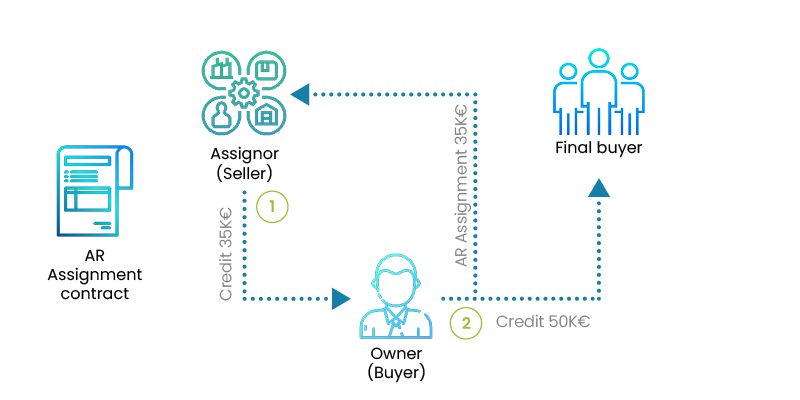
An assignment does not automatically eliminate the risk of non-payment or protect the assignee from every insolvency-related challenge. Its effectiveness may depend on notification, enforceability against third parties, priority rules and the underlying claim.
Delegation, Direct Payment or Assignment: Which Is Appropriate?
| Mechanism | Main principle | Key point to verify |
|---|---|---|
| Delegation of payment | A third party undertakes to pay the supplier. | Whether the original debtor remains liable and the exact scope of the undertaking. |
| Statutory direct payment | An eligible subcontractor receives payment under public procurement rules. | Eligibility, approvals and procedural compliance. |
| Assignment of receivables | An existing receivable is transferred to another creditor. | Validity, notification, priority and debtor defences. |
These arrangements can support a broader receivables protection strategy alongside customer credit limits, advance payments and other receivables security techniques.
This article is an educational overview, not legal advice. For material exposures or cross-border transactions, have the proposed agreement reviewed under the applicable law.
