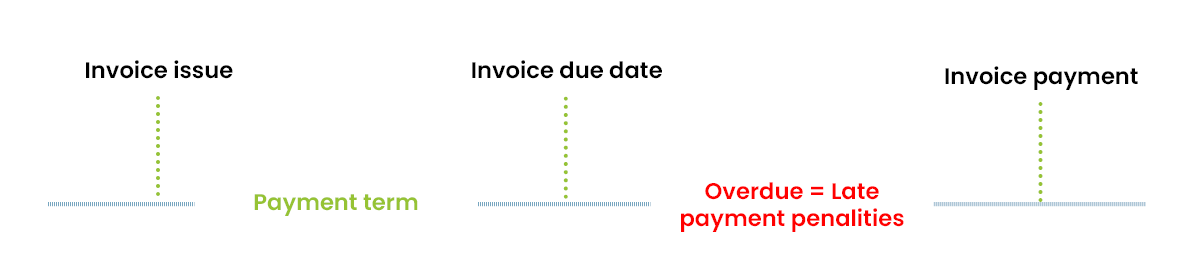
Late payment penalties are due when a customer fails to pay an invoice by its contractual due date. They compensate the supplier for the financial consequences of delayed payment and, just as importantly, reinforce a culture of respecting payment terms.
Yet many companies mention penalties in their terms and conditions without ever claiming them. Is that really the best way to manage customer credit?
Late payment penalties: the legal framework
In France, for business-to-business transactions covered by the French Commercial Code, late payment penalties are generally payable automatically from the day after the contractual payment deadline, without any reminder being necessary. The principle was introduced through the NRE reforms and reinforced by the 2008 Law on the Modernisation of the Economy (LME).
The buyer who fails to pay on time becomes liable for the penalties. In theory, the supplier should not even have to claim them: the buyer should pay them spontaneously. In practice, this rarely happens.
Commercial documents, including the general terms and conditions of sale and invoices, must contain the required information about the payment deadline, late-payment penalty rate and fixed recovery compensation. The French Commercial Code, notably Article L441-10 and the invoicing provisions in Article L441-9, establishes the applicable framework. Failure to comply with mandatory invoicing or payment-term rules can expose a business to significant sanctions; the precise provisions and amounts depend on the infringement.
Since 2013, qualifying late B2B payments in France also give rise to a fixed recovery compensation of €40 per invoice, in addition to late payment penalties. See our dedicated explanation of fixed recovery compensation.
International perspective
Late-payment interest is not uniquely French. The European Union established a framework for combating late payment in commercial transactions through Directive 2011/7/EU, implemented in national law. In the United Kingdom, statutory commercial late-payment interest is generally 8 percentage points above the Bank of England base rate, subject to the relevant contractual and statutory rules. In the United States, applicable interest rates and enforceability vary by state, contract and transaction type; there is no universal federal B2B penalty rate.
For international business, always check the governing law and contractual terms. French statutory rates and the French €40 compensation cannot simply be applied to every overseas customer.
Which late payment penalty rate should you apply?
French law allows the seller to specify a contractual late-payment rate, provided it is not lower than three times the applicable statutory legal interest rate. In the absence of a different compliant contractual rate, the statutory default is based on the European Central Bank reference rate plus 10 percentage points, according to the applicable calculation rules.
The French tutorial reports the following figures for the second half of 2026: a legal interest rate of 2.75%, giving a contractual minimum of 8.25% annually, and a referenced ECB-based rate of 12.40%. These are period-specific figures: check the officially published rate applicable to your transaction before using them.
In general, we recommend choosing a fixed annual rate between the applicable legal minimum and 15%, provided it complies with the rules governing the transaction. A rate of 12% per year is often a good choice: it is easy to understand, corresponding to approximately 1% of the invoice amount per month of delay, and sufficiently dissuasive to be meaningful. The exact daily calculation is still based on the applicable day-count convention.
Why avoid simply reproducing the ECB reference rate plus 10 percentage points in your commercial terms? Because it moves with monetary policy. A clearly stated fixed rate is easier to communicate and administer, as long as it remains above the statutory minimum whenever applicable.
Where should the rate appear?
In France, the rate must be included in the relevant commercial documentation, including general terms and conditions of sale and invoices. A straightforward clause might read: “Late payment penalties are calculated at an annual rate of 12%, from the day after the contractual payment due date.” This wording should be supplemented with the required information about fixed recovery compensation and adjusted to the applicable legal framework.
How to calculate late payment penalties
For a standard simple-interest calculation, the amount depends on the overdue balance, the annual rate and the number of days of delay:
The calculation convention may vary according to the law and contract. For French B2B invoices, penalties are generally calculated on the invoice amount including VAT.
Worked example
A customer pays a €24,000 invoice including VAT 45 days after its due date. With an applicable annual penalty rate of 12% and a 365-day calculation basis:
The supplier can therefore claim €355.07 in interest under these assumptions, plus the €40 fixed recovery compensation if the French B2B rules apply. For multiple overdue invoices, calculate each amount according to its balance and period of delay.
Late payment penalties or default interest in public procurement?
In France, the term intérêts moratoires (default interest) is particularly common in public procurement. Public buyers are subject to specific payment deadlines and rules requiring default interest and, where applicable, fixed compensation for late payment. These rules should not be confused with the contractual framework used between private companies.
For the relevant French public-sector framework, consult the official Service Public guidance for businesses. The public buyer's status, contract and applicable regulation determine the deadline and rate.
Late payment penalties in practice: overcome the psychological barrier
The legal obligation to pay penalties is only partially reflected in business practice. Some suppliers simply include a clause in their terms and conditions and never ask for payment. Others have overcome the psychological barrier: they claim penalties systematically, collect them in some cases, and use them as a negotiating asset in others.
The main obstacle is the fear of damaging the commercial relationship. In most cases this fear is unfounded. How could a buyer legitimately criticise a supplier for applying the law or requiring invoices to be paid on their agreed due dates?
Professional cash collection and a consistent penalty policy strengthen the supplier's credibility. A lax approach has the opposite effect. Suppliers who clearly request penalties can obtain at least part of them, and their collection strategy becomes more convincing to customers.
In practice, some public bodies pay default interest automatically. Some private companies pay penalties after an insistent request, especially where the supplier has a strong negotiating position. Even when the full amount is not collected, it can provide leverage to secure prompt payment of the principal, resolve a dispute or agree a firm payment commitment.
Surveys conducted by Etrepaye.fr in 2013, 2014, 2016 and 2019 explored how businesses actually apply these rules. They illustrate the persistent gap between statutory rights and commercial practice; they should not be presented as a representative international survey.
Why apply penalties?
- Educate customers to respect contractual due dates.
- Compensate the financial cost of late payment.
- Protect profitability and reduce the burden of overdue receivables.
- Give weight to collection actions and payment commitments.
- Comply with applicable law and make payment terms credible.
Adopt a culture of late payment penalties. Not only can it improve payment behaviour, but it can also provide financial compensation when delays occur. The issue is not to be aggressive; it is to be professional and consistent.
Late payment penalties in My DSO Manager
Late payment penalties can be calculated automatically in My DSO Manager when enabled for a customer or when the situation requires it. The amounts can be included in account statements, balances claimed and collection communications, including interactive emails, registered electronic letters, conventional letters and SMS, using the rate configured in the software.
Integrating penalties into the collection workflow makes it easier to apply a coherent policy across the portfolio while retaining the ability to adapt individual actions to the customer relationship.
Frequently asked questions
Do late payment penalties have to be invoiced?
Under the French B2B rules, penalties arise automatically and a separate invoice is not necessary for them to become due. A debit note or other accounting document may nevertheless help communicate and record the amount. Genuine late-payment interest is generally outside the scope of VAT.
Can penalties be claimed after the invoice has been paid?
Yes, under French law, paying the principal late does not in itself extinguish the right to claim accrued penalties. The applicable limitation period and any relevant interruption or suspension rules must be considered. Commercial claims are generally subject to a five-year limitation period, but its starting point requires examination of the claim.
What if the customer initiates a transfer before the due date but the funds arrive later?
In general, the payment must reach the creditor within the agreed deadline. Merely initiating a transfer before the due date does not necessarily mean that payment was made on time. Check the contract, payment method and applicable rules.
Are penalties calculated on amounts before or after VAT?
For French B2B late-payment penalties, the calculation is generally based on the overdue invoice amount including VAT. The penalties themselves are not subject to VAT when they genuinely compensate for late payment.
Can penalties be imposed on consumers?
Consumer transactions are subject to a different legal framework. The B2B rules and the French fixed €40 recovery compensation should not automatically be applied to private individuals. Review consumer law and contractual enforceability separately.
Can a supplier add a flat 10% penalty after one month?
Do not assume that an additional flat penalty can simply be combined with statutory interest and fixed recovery compensation. Such clauses may be assessed under rules governing contractual penalties, unfair terms and proportionality. A carefully drafted, compliant annual interest rate is usually clearer.
Conclusion: apply penalties with professionalism and common sense
Many companies remain reluctant to claim late payment penalties, even though they have a clear commercial and financial purpose. This hesitation weakens the credibility of agreed payment terms.
Be innovative and manage your receivables professionally: apply late payment penalties, request their payment clearly, and rely on both the law and common sense. They are not a substitute for effective collection, but an important part of it.